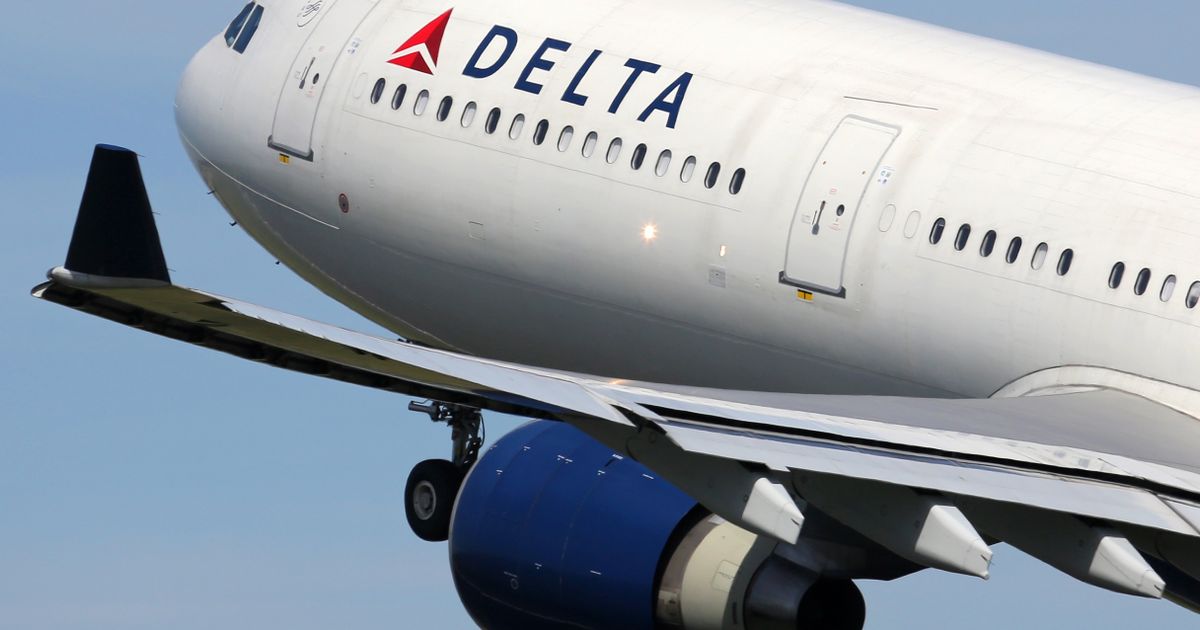
Delta reported mixed Q4 results with EPS of $1.55 beating the $1.53 consensus but adjusted revenue of $14.61 billion missing the $14.72 billion estimate and passenger revenue coming in at $12.92 billion versus a $13.07 billion forecast; shares fell nearly 3% after the revenue shortfall and management said a government shutdown cut travel by ~2 points. Operating revenue was $16.0 billion, operating income $1.5 billion (9.2% operating margin), and Delta posted record full-year revenue with double-digit return on invested capital; the company expects ~20% earnings growth in 2026 and projects March-quarter revenue growth of 5–7% year-over-year.
Market structure: Delta’s mixed Q4 (EPS beat, revenue miss) benefits well-capitalized incumbents with diversified networks (DAL) and airport slot control, while low-cost carriers with weaker balance sheets (e.g., AAL) are most exposed if demand softens. A government-shutdown-driven ~2ppt demand hit suggests shallow, idiosyncratic demand shocks rather than systemic weakness; pricing power should reassert if unit revenues (RASM) recover by >3% QoQ. Cross-asset: a sustained oil move above $90/bbl or 10-yr Treasury +50bps would compress margins and widen credit spreads for lower-rated airline debt within 1–3 months.
Risk assessment: Tail risks include protracted travel disruption from repeated government shutdowns, fuel shock, or coordinated labor actions — each could compress EBITDA by 15–30% in a downside scenario over 3–6 months. Short-term (days–weeks) volatility will hinge on next traffic prints and macro headlines; medium-term (quarter) risks center on RASM and capacity discipline; long-term (years) depends on fleet financing costs and ROIC sustainability. Hidden dependency: Delta’s superior ROIC masks exposure to corporate travel mix recovery; a lagging corporate rebound would reduce guided 20% EPS growth.
Trade implications: Favor selective long in DAL vs peers using capital-light options: establish a 2–3% long position in DAL equity with 3–6 month upside call spreads to limit downside, and a 1–1.5% short position in UAL or AAL as a pair trade to capture relative operational leverage. If implied volatility is low, buy 3–6 month DAL 25–40% OTM call spreads sized to 1–1.5% notional; hedge with short-dated puts if DAL falls >8% intraday. Rotate modestly into Travel & Leisure cyclicals (marinas, CNK) only if oil stays < $75 and 10-yr <3.5% over next 60 days.
Contrarian angles: Consensus fixates on the revenue miss but underprices Delta’s margin durability and double-digit ROIC — if March-quarter revenue grows 5–7% as guided and RASM stabilizes, DAL could re-rate +15–25% within 3–6 months. The market may over-penalize near-term demand noise; look for buying opportunities on any >5% pullback or better-than-expected mid-quarter traffic metrics (ATPCO yields up >2% QoQ). Conversely, beware complacency: oil breach of $95 or labor strike headlines are binary downside catalysts.
AI-powered research, real-time alerts, and portfolio analytics for institutional investors.
Request DemoOverall Sentiment
mixed
Sentiment Score
-0.05
Ticker Sentiment
