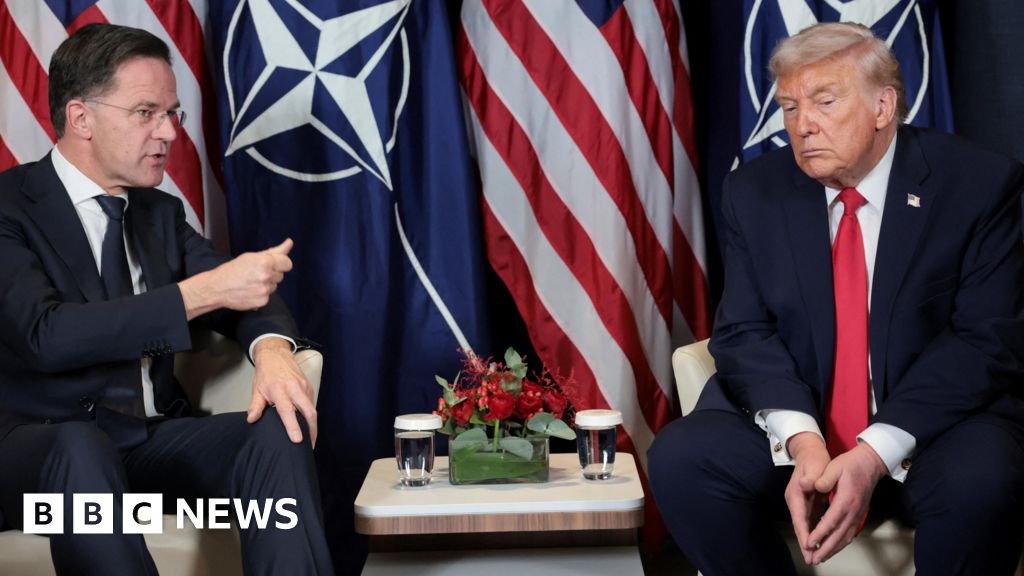
Threat of US withdrawal from the 32-member NATO resurfaced after President Trump publicly criticized allies following a private White House meeting with NATO Secretary General Mark Rutte. Rutte pushed back, saying the large majority of European nations provided basing, logistics and overflights, while the White House accused NATO of failing during the Iran conflict. Congress has already restricted unilateral withdrawal by requiring a two-thirds Senate majority or an act of Congress, but renewed tensions raise geopolitical risk that could lift oil-price sensitivity via the Strait of Hormuz and increase defensives' market sensitivity.
The immediate market effect of escalating public friction between the US President and NATO is a rise in political risk premia that favors defense procurement and energy security plays while penalizing exposed transport/travel cash-flows. Price mechanics are straightforward: uncertainty around basing agreements and collective action raises the probability of incremental US/EU emergency logistics and munitions buys (accelerating deliveries and front-loading spend), which tends to compress lead times and push near-term revenues for prime contractors higher by measurable percentages over the next 6–18 months.
Second-order supply-chain effects matter: elevated demand for precision munitions, aerial refueling and transport assets will increase price leverage for Tier-1 suppliers and force Tier-2/subsystem suppliers to reprice contracts or face bottlenecks — expect margin expansion for assemblers and 4–9 week inflationary pressure on components (avionics, composite structures). Separately, any credible threat to Strait of Hormuz transit plugs into a volatile oil-insurance feedback loop where a ~1m bpd credible disruption historically moves Brent $8–12/bbl in weeks and raises voyage charter and war-risk premiums, amplifying jet-fuel cost shocks for airlines.
Time horizons: markets will react in days on headlines, trade and insurance costs will repriced over weeks, and procurement/appropriation responses take 6–24 months to materialize in contractor bookings. Reversal vectors include de-escalatory diplomacy, a legal/political check on unilateral US withdrawal, or a clarified EU commitment that removes uncertainty — any of which can swiftly compress the current risk premia and produce sharp mean reversion in defense and oil-related trades.
AI-powered research, real-time alerts, and portfolio analytics for institutional investors.
Request DemoOverall Sentiment
mildly negative
Sentiment Score
-0.25
