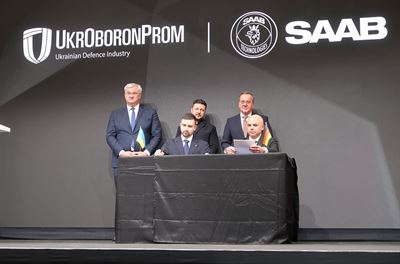
Saab and Ukraine's Joint Stock Company “Ukrainian Defense Industry” (JSC UDI) signed a memorandum of understanding at the Munich Security Conference 2026 to collaborate on aviation and airborne surveillance systems, combining Saab's technology and JSC UDI's role as a consolidated state defence manufacturer. The MoU underlines Saab's strategic commitment to supporting Ukraine's defense capability and could presage future industrial cooperation or contracts, but contains no financial terms and is unlikely to materially affect Saab's near‑term earnings or market position.
Market structure: The Saab–JSC UDI MoU is a demand signal for airborne surveillance, avionics and sustainment capacity concentrated in Europe and Ukraine; direct winners are mid‑tier European defense primes (SAAB B, RHM.DE, BAE.L) and specialist avionics/sensor suppliers, which could see contract pricing power lift 5–15% for niche systems over 12–24 months. Losers are marginal: non‑defense commercial aerospace suppliers and airlines (BA, AIR.PA, JETS) who do not capture rearmament spend and may face resource reallocation in supply chains. Cross‑asset: expect bid for European defense equities, modest tightening in SEK vs peers if Saab order visibility improves, small upward pressure on nickel/steel and semiconductor specialty chips; Ukrainian sovereign risk premium likely to stay elevated, keeping CDS and local currency volatility higher.
Risk assessment: Tail risks include export‑license freezes, geopolitical escalation that triggers sanctions (10–30% downside for exposed primes), and supply‑chain chokepoints for RF chips or precision bearings; probability ~10–15% next 12 months. Time horizons: immediate market moves (days) likely muted; short‑term (weeks–months) sentiment driven by EU/US aid tranches and export approvals; long‑term (2–4 years) is where Ukrainian industrial consolidation can generate durable revenue but requires capital, certification and lead times. Hidden dependencies: Western ITAR/GDPR export controls, subcontractor concentration (few RF chipmakers), and financing from EU/US budgets. Key catalysts: EU/US aid votes, further MoUs at NATO forums, and first contract awards (within 3–9 months).
Trade implications: Direct plays are concentrated small‑to‑mid cap European defense longs (SAAB B: STO:SAAB B; RHM.DE) sized 1–3% each with 6–12 month horizons; hedge via modest short exposure to commercial aerospace (BA) to isolate defense rerating. Options: buy 9–12 month SAAB calls 10–20% OTM or call spreads to cap cost, and buy short‑dated puts (3 months) as tail protection against sanctions news. Sector rotation: increase allocation to Aerospace & Defense by 300–400bps funded by reducing commercial aerospace/airline exposure; enter positions within 2–6 weeks and plan to take profits at +25–35% or after formal contract awards.
Contrarian angles: Consensus assumes fast revenue conversion; realistically Ukraine integration will take 2–4 years — near‑term gains are sentiment‑driven and may be overdone if export controls bite. Historical parallel: post‑2014 European rearmament produced multi‑year backlog but uneven quarterly revenues and margin volatility for mid‑caps. Unintended consequences include supplier inflation and longer certification cycles that compress margins in year‑1; downside is underappreciated and justifies disciplined sizing and active hedges.
AI-powered research, real-time alerts, and portfolio analytics for institutional investors.
Request DemoOverall Sentiment
mildly positive
Sentiment Score
0.28
