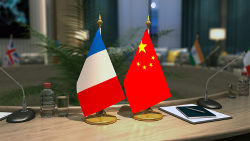
French President Emmanuel Macron will undertake a state visit to China from December 3-5 aimed at reinforcing China-France ties amid a volatile international backdrop. A CGTN poll of 8,308 participants in 24 hours found broad support for deeper China-Europe cooperation—notably 75% backing stronger economic cooperation, 86.5% viewing China's high-quality opening as an opportunity, and multiple >90% readings urging rational engagement and upholding multilateralism—signals that diplomatic rapprochement is widely seen as de-risking bilateral relations and supportive of stable economic engagement between China and Europe.
Market structure: A favourable China–France/Europe diplomatic reset mechanically benefits exporters and capital goods suppliers that rely on Chinese demand—luxury (LVMH MC.PA, KER.PA, RMS.PA), aerospace (AIR.PA), and energy/service firms (TTE.PA, VINCI FW:)—and will support freight, industrial metals, and container shipping volumes. Losers are likely defensive and geopolitically exposed names (European defence primes, and exporters dependent on U.S.–China tech decoupling) as political capital shifts toward trade; expect modest EUR strength (0.5–2%) on positive headlines which will compress EUR-hedged EM FX carry. Competitive dynamics: renewed openness lowers trade frictions and increases pricing power for premium brands in China while incrementally restoring order- book visibility for aircraft and energy contracts, improving order-intake risk-adjusted cash flows over 3–12 months.
Risk assessment: Tail risks include a policy reversal from EU political backlash or new U.S. sanctions on tech transfers (low-probability, high-impact) and a China growth shock (CNY down >3% in 30 days) that would reverse demand assumptions. Immediate (days): headline-driven volatility around the visit; short-term (weeks–months): order announcements and FX moves; long-term (quarters–years): structural re‑anchoring of supply chains and firm-level capex. Hidden dependencies: actual deal conversion rates historically run 20–40% of headline MoUs; Chinese local government financing could be the true swing factor. Catalysts to watch: formal aircraft/energy procurement announcements, bilateral financial accords, and any trade facilitation memoranda within 0–90 days.
Trade implications: Direct plays—establish a 2–3% long in LVMH (MC.PA) and 1–2% in AIR.PA into potential order announcements, targeting 6–12 month holding periods; overweight TTE.PA (1–2%) for energy project upside if Sino-French energy MOUs appear. Pair trades—long MC.PA vs short a US retail/consumer discretionary ETF (XLY) sized 1–1.5% to express China-specific luxury outperformance. Options—buy 3–6 month call spreads on MC.PA (capped risk) and sell 1–2 month strangles on EUR vs USD if IV spikes post-visit; hedge material positions if CNH moves >3% within 30 days. Entry: size into confirmed press releases (buy within 24–72 hours of MoU); exit or trim if EUR gains >2% or headline conversion <20% after 90 days.
Contrarian angles: The market’s optimistic consensus underestimates conversion risk—state visits often produce PR-heavy MoUs, not immediate revenue; price in only 20–40% conversion when sizing positions. Implied volatility on luxury names may be too low relative to geopolitical tails; asymmetric option buys (call spreads) offer better skew capture. Historical parallels (previous EU state visits to China) show durable sentiment boosts but modest short‑term EPS beats; if CNH weakens or EU domestic politics harden, reopening trades will reverse quickly, creating a 4–8% downside swing in exposed equities within 1–3 months.
AI-powered research, real-time alerts, and portfolio analytics for institutional investors.
Request DemoOverall Sentiment
mildly positive
Sentiment Score
0.25
