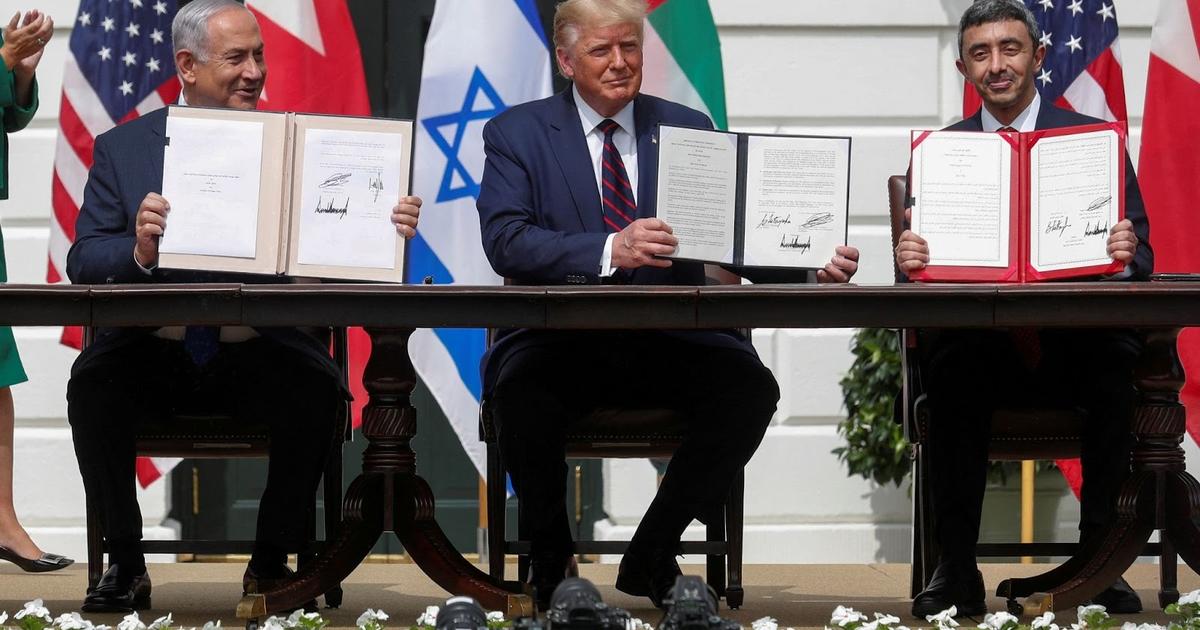
A recent agreement for hostage release and a cessation of hostilities in Gaza, part of the 'Trump Peace Initiative,' was facilitated by the UAE, underscoring its pivotal role in regional diplomacy. This development occurs amid the five-year anniversary of the Abraham Accords, which have fostered over $11.7 billion in bilateral trade and significant investments, such as Mubadala's $1.1 billion in Israel's Tamar gas field. Despite these strong economic ties, the Accords face strain from the Gaza conflict and potential West Bank annexation, with the UAE indicating possible diplomatic downgrades, highlighting persistent geopolitical risks that could impact broader regional integration and stability.
A recent agreement, part of the 'Trump Peace Initiative,' has been reached for the release of hostages and a cessation of hostilities in Gaza, aligning with Israel's core objectives of hostage return, Hamas exclusion from governance, and disarmament. The United Arab Emirates played a pivotal role in facilitating this breakthrough through its constructive engagement and quiet diplomacy, demonstrating its commitment to dialogue over hostility in the region. This development underscores the UAE's strategic importance as a partner for peace.
The Abraham Accords, now five years old, have fostered significant economic integration, with bilateral trade surpassing $11.7 billion and the Comprehensive Economic Partnership Agreement (CEPA) eliminating tariffs on over 96% of goods. Key investments, such as Mubadala's $1.1 billion in Israel's Tamar gas reservoir, and cooperation in sectors like AI, agritech, cyber, and renewable energy, highlight the tangible benefits and strategic depth of this partnership. Initiatives like IMEC further exemplify the potential for transformative regional collaboration.
Despite these achievements, the Accords face considerable strain from the ongoing Gaza conflict and threats of West Bank annexation, which the UAE considers a "red line." While trade ties remain intact, the broader regional integration envisioned under the Accords is challenged, and the UAE has indicated a potential for diplomatic downgrades rather than outright severance. This geopolitical friction introduces uncertainty, despite the article's optimistic tone regarding the Accords' long-term resilience.
The mixed sentiment and moderate market impact score reflect the dual nature of the situation: significant progress in regional cooperation juxtaposed with persistent geopolitical risks. The article emphasizes the need for collective commitment to ensure lasting peace and stability, suggesting that the future trajectory of these partnerships hinges on navigating these complex challenges effectively.
AI-powered research, real-time alerts, and portfolio analytics for institutional investors.
Request DemoOverall Sentiment
mixed
Sentiment Score
0.00
