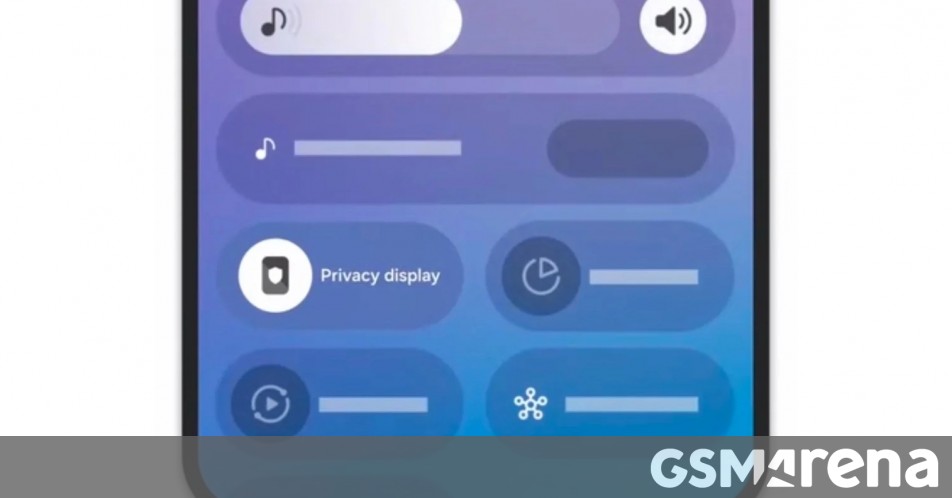
Samsung's One UI 8.5 confirms a Privacy Display feature for the Galaxy S26 Ultra that narrows viewing angles so only the device owner can see the screen; it offers two intensity levels including a 'Maximum privacy protection' mode, automatic activation via Modes & Routines, and a Quick Settings toggle. The announcement signals an incremental, privacy-focused software enhancement ahead of the S26 Ultra launch rather than a major hardware upgrade, suggesting limited near-term financial impact on Samsung's consumer demand trajectory.
Market structure: Samsung’s Privacy Display is a marginal product differentiator that favors device makers and display-panel suppliers capable of narrow-view-angle technology (Samsung Electronics/SSNLF, LG Display 034220.KS, BOE 000725.SZ). If adopted broadly, handset OEMs can marginally preserve on-the-go usage premium; expect 1–3% upside in component order volumes for niche privacy-panel layers over 12 months, but limited pricing power as consumers resist hefty premiums (>~$50). Cross-asset: modest positive for Korean tech equities and NOK/KRW on fund flows; negligible macro impact on commodities or sovereign bonds unless scaled across industry.
Risk assessment: Tail risks include major usability backlash (reviews saying viewing cone too narrow) that could depress demand for S26 by >5% QoQ and spark returns; regulatory scrutiny over “invisible screens” (privacy labeling/consumer safety) in EU/US within 3–12 months is low probability but high impact. Short-term (days–weeks) volatility centers on product reviews and pre-order data; medium-term (3–9 months) depends on supply cadence and component lead-times; long-term (12–36 months) depends on feature migration to mid-tier phones. Hidden dependencies: battery life, brightness trade-offs, and integration with Android One UI could mute uptake.
Trade implications: Direct plays: favor small-long positions in display/component suppliers with exposure to privacy-layer tech (SSNLF, 034220.KS) and selectively overweight SOXX by 1–2% for increased sensor/ISP demand over 3–9 months. Relative value: pair long SSNLF (2%) / short AAPL (AAPL) (1%) as a hedge if Samsung captures incremental share in premium Android phones; close if SSNLF outperforms AAPL by >8% in 60 days. Options: buy 3-month calls on SSNLF (~10–15% OTM) ahead of launch and buy 3-month AAPL puts (5–8% OTM) sized to 1% notional to limit capital at risk.
Contrarian angles: Consensus overstates Apple’s vulnerability — Apple’s ecosystem lock-in means feature parity rarely flips share quickly; the market may underprice execution risk and consumer resistance to viewing-cone trade-offs. Historical parallels: incremental hardware privacy features (e.g., notch elimination, in-display fingerprint) delivered supply-chain winners but limited lasting pricing power; expect similar pattern here. Unintended consequences: poor implementation could accelerate consumers toward software privacy solutions or accessories, shifting revenue to third-parties rather than OEMs.
AI-powered research, real-time alerts, and portfolio analytics for institutional investors.
Request DemoOverall Sentiment
neutral
Sentiment Score
0.15
Ticker Sentiment
