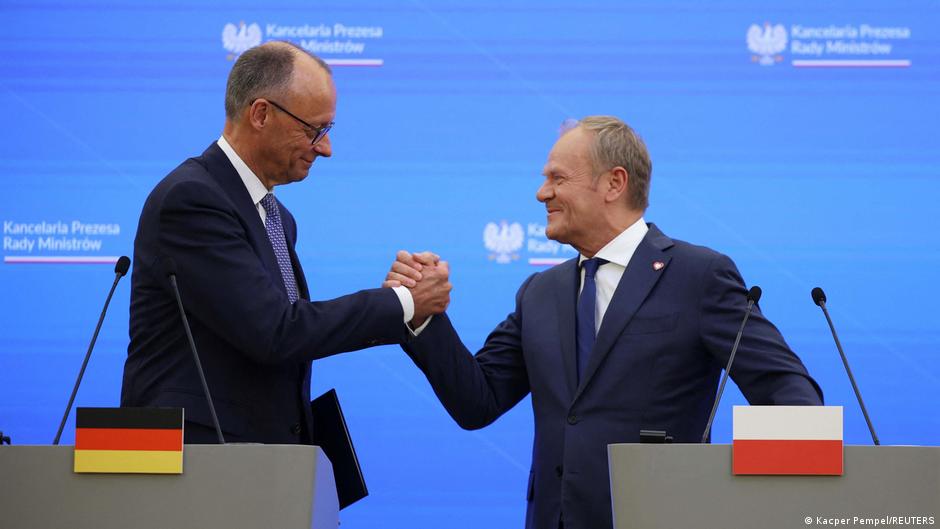
Poland's new government led by Donald Tusk will meet Germany under Chancellor Friedrich Merz amid unresolved tensions over WWII reparations — PiS previously demanded 6.2 trillion Zloty (≈€1.5tn/$1.7tn) and Poland's President Karol Nawrocki has renewed demands — while an earlier German offer of €200m for roughly 60,000 surviving victims was rejected. Bilateral friction is compounded by Germany's unilateral border checks that have disrupted commuters, businesses and carriers, even as security cooperation advances (Patriot air defenses, German jets, and planned joint work on drones and long‑range missiles); a limited humanitarian or cultural restitution gesture (return of Teutonic Order archives and a medieval sculpture) is seen as key to any breakthrough.
Market structure: The near-term winners are European defense suppliers (air-defence, drones, missiles) as NATO front-line spending and bilateral procurement talks (Poland–Germany) increase demand; expect a 10–30% incremental procurement uplift in targeted categories over 12–36 months vs baseline. Losers are cross-border logistics, short-haul freight carriers and integrated automotive suppliers operating large Poland–Germany routes where border checks raise transit times and unit costs by an estimated 5–15% in months with persistent checks. FX and sovereign spreads: expect episodic PLN weakness and 10y Poland-Bund spread widening of 10–50bps on negative diplomatic headlines.
Risk assessment: Tail risks include a diplomatic freeze or punitive trade measures (low probability <10% but would cause >5% GDP hit to border regions and sharp PLN selloff) and German domestic political pushback that delays deliveries (medium probability). Timeframes: immediate (days) volatility in FX and logistics earnings; short-term (weeks–months) contract announcements or archive/artifact returns; long-term (years) structural defense capex and regional supply-chain re-routing. Hidden dependency: German capacity constraints—accelerated NATO demand may create procurement timing slippage and margin pressure for vendors.
Trade implications: Direct plays — size tactical longs in European defense names with Polish exposure (RHM.DE, HDO.DE) via equity or 3–9 month call spreads; hedge macro tail risk by trimming 1–2% portfolio exposure to Polish sovereign bonds and buying EUR/PLN forwards (1–2% notional) for 1–3 months. Sector rotation — overweight European Aerospace & Defense ETF (3–5% overweight) and underweight European Transport/Logistics (reduce by 2–4%); enter within 1–4 weeks, scale up if bilateral procurement MOUs materialize.
Contrarian angles: Consensus focuses on politics; market may underprice durable defense demand even if reparations remain unresolved — defensive industrials could rerate by 15–40% on multi-year contracts. The knee-jerk PLN/Polish bond selloff may be overdone if Tusk secures a humanitarian gesture within 30–90 days; that would reverse FX and spread moves. Watch for unexpected outcomes: stronger German support could crowd out smaller suppliers and create execution risk for midsized defence names.
AI-powered research, real-time alerts, and portfolio analytics for institutional investors.
Request DemoOverall Sentiment
neutral
Sentiment Score
-0.05
