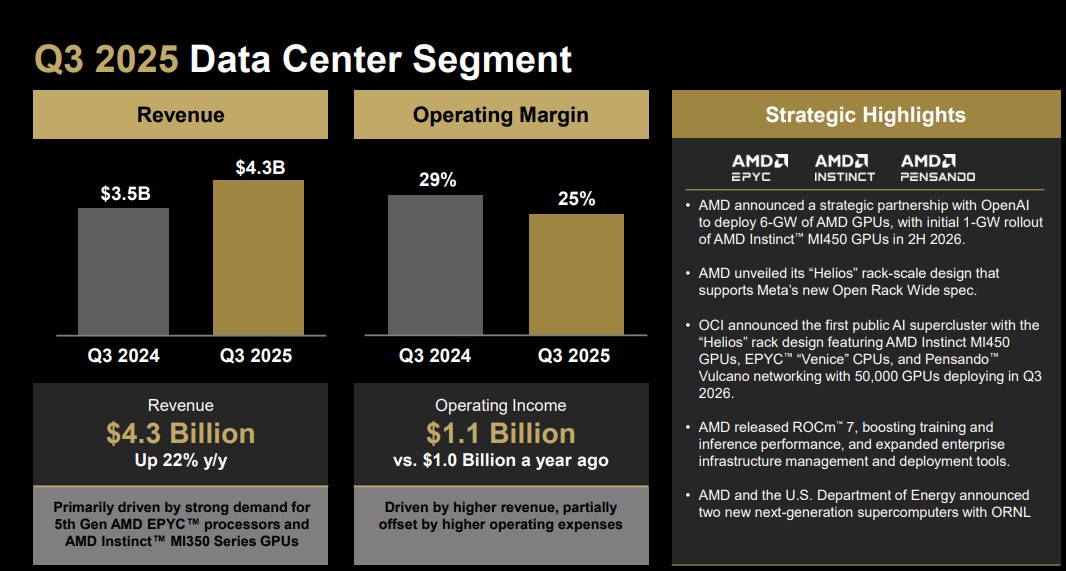
AMD shares fell about 7.5% after its Nov. 4 third‑quarter report despite a solid topline as investors focused on macro and geopolitical risks and company metrics that raised concern: data‑center revenue was $4.3 billion (+22% year‑over‑year) but operating margin contracted by 400 basis points, and the stock has already rallied ~91% in 2025. Headwinds cited include a protracted U.S. government shutdown, constrained access to China’s AI market, and supply‑chain exposure via TSMC amid Taiwan‑China tensions, which together amplify sensitivity to any slowdown in AI capex. Offsetting those risks, AMD has rapidly built a competitive AI accelerator platform, won hyperscaler customers (Oracle, Meta, Microsoft), signed a 6‑GW deal with OpenAI, and management is guiding to higher revenue and improving margins—factors the author argues justify a premium forward P/E (~58) and make the recent pullback a buying opportunity for long‑term AI infrastructure exposure.
AMD reported third-quarter results on Nov. 4 and its shares fell roughly 7.5% through Nov. 18 as investors digested macro and geopolitical headwinds and stretched momentum after a ~91% 2025 rally. The report showed data-center revenue of $4.3 billion, up 22% year‑over‑year, but operating margin contracted by 400 basis points, which heightened concern that AMD is growing revenues without near‑term margin leverage.
AMD has demonstrable secular wins: it has rapidly built a competing AI accelerator platform adopted by hyperscalers including Oracle, Meta and Microsoft, is bringing MI450 chips to market, and signed a 6‑gigawatt deal with OpenAI, while management guides to higher revenue and expanding margins. The broader AI infrastructure opportunity is large (industry capex cited at $3–4 trillion over coming years) and Nvidia’s CEO estimates China alone is a $50 billion addressable AI market, though China access is constrained by policy.
Valuation and execution are the crux: forward P/E near 58 looks rich given uneven profitability across segments and a data‑center business still scaling, and near‑term risks include US political uncertainty, China market restrictions and TSMC/Taiwan supply‑chain exposure. If AMD can convert multi‑year hyperscaler contracts into sustained margin expansion, the stock can justify premium multiples; until then, the path is execution‑driven and sensitive to macro/geopolitical shocks.
AI-powered research, real-time alerts, and portfolio analytics for institutional investors.
Request DemoOverall Sentiment
mildly positive
Sentiment Score
0.35
Ticker Sentiment
