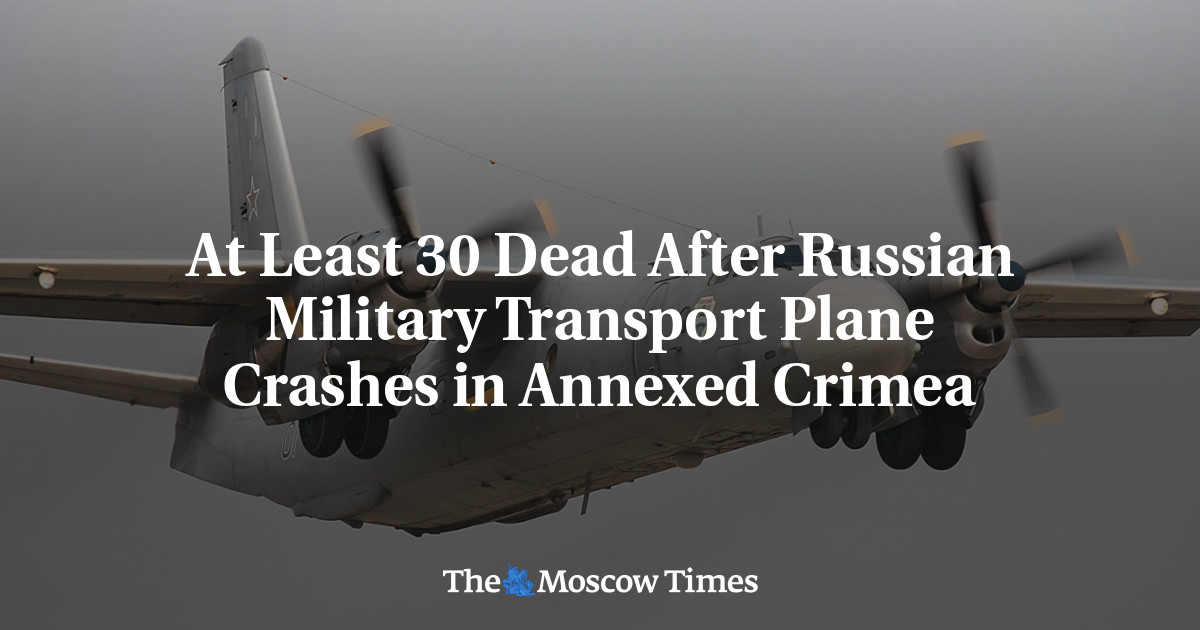
30 people were killed when an Antonov An-26 military transport crashed in annexed Crimea; the aircraft carried 23 passengers and 7 crew and lost contact around 6 p.m., crashing about 25 km east of Sevastopol. Russia's Defense Ministry cited a likely 'technical malfunction' and said there was no sign the plane was shot down, while the Investigative Committee has opened a criminal probe into possible safety violations.
Operationally, this incident magnifies a chronic vulnerability: aging tactical airlift fleets have thin spare-part inventories and limited surge capacity, so even small attrition events force outsized reroutes and maintenance cascades. Expect a 2–12 week window of elevated mission delays for regions dependent on legacy transports as crews and airframes are reallocated; that drives increased demand for contracted heavy-lift sorties and MRO work.
Market-wise, the immediate pricing mechanism is a short-lived geopolitical risk premium (days–weeks) that lifts defense contractors with exposure to airlift, ISR, and maintenance solutions; procurement cycle responses (new contracts, accelerated upgrades) take 3–12 months to show up in revenue. Conversely, insurers and reinsurers are unlikely to see large insured losses because military-operations exclusions and state self-insurance blunt payouts, meaning any market sell-off in insurance names would be a knee-jerk, not fundamental, move.
Tail risks and catalysts: a criminal probe that uncovers systemic maintenance failures or supply-chain shortfalls (e.g., sanctioned parts, undocumented repairs) could force policy and budgeting changes within 6–18 months, accelerating fleet retirements and Western procurement to fill capability gaps. The main reversal is quick—if the event is ruled hostile, risk premia spike immediately; if mechanical and traced to a single-component failure, market impact will fade and the procurement bid becomes the only lasting effect.
AI-powered research, real-time alerts, and portfolio analytics for institutional investors.
Overall Sentiment
strongly negative
Sentiment Score
-0.70
