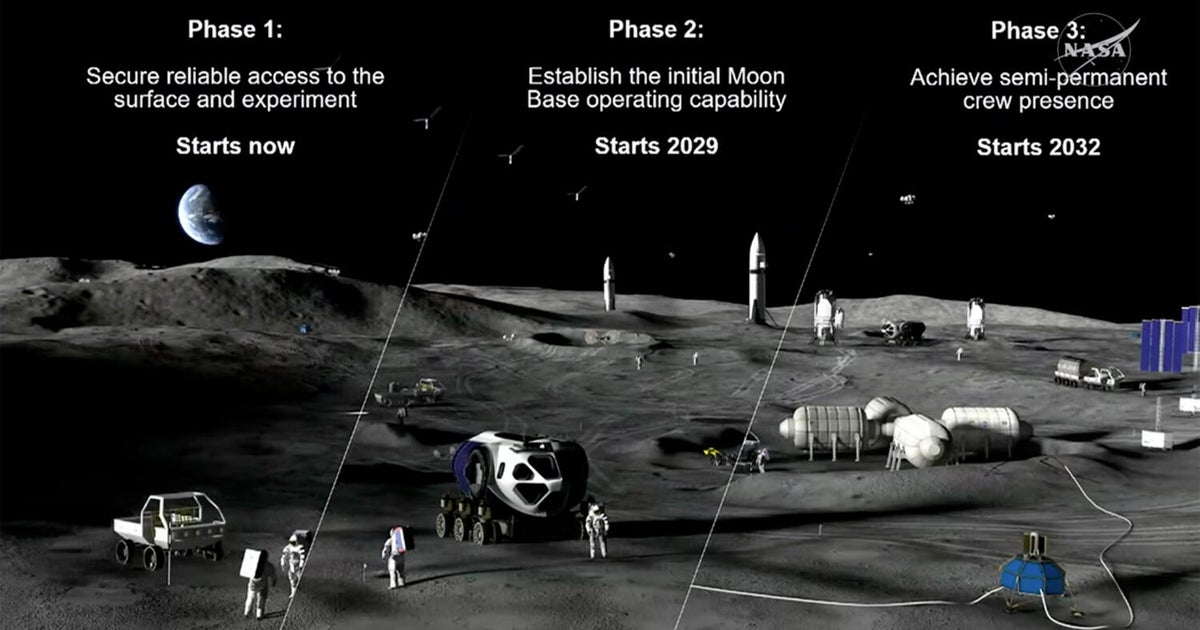
NASA unveiled a $20 billion plan over seven years to build a lunar base near the south pole with habitats, pressurized rovers and nuclear power systems, targeting a cadence of two crewed moon landings per year. The agency will pause the Gateway orbital station, repurpose its modules for surface operations, shift from the government SLS rocket to competitive commercial launchers (e.g., SpaceX, Blue Origin), and accelerate space nuclear power development (SR-1/Skyfall in 2028). NASA also plans measures to spur commercialization of low-Earth orbit after ISS retirement and says the program will be funded by reprioritizing existing budgets and trimming inefficiencies. The initiative is explicitly framed as a strategic effort to outpace China and should be sector-moving for aerospace, defense and commercial-space contractors.
The programmatic pivot from monolithic orbital architectures to surface-first, high-cadence missions will create concentrated demand for modular, repeatable hardware and services rather than unique one-off systems. Expect procurement to favor suppliers that can industrialize production (additive manufacturing, standardized avionics, pressurized-hab systems) and demonstrate rapid turnarounds — a 2–3x premium on schedule predictability could be priced into contract awards over the next 12–36 months.
A parallel, underappreciated chain reaction is the near-term spike in demand for high-reliability thermal management, radiation-hardened power electronics, and small fission-compatible components; these are niche markets with few qualified vendors, so incumbents with pedigree in terrestrial small-modular reactors and space-qualified power (thermal, shielding, control systems) can capture outsized margin expansion. Supply-side constraints (precision titanium, specialty ceramics, high-temp lubricants) will show lead times of 9–18 months and create opportunities for vertical integration or toll-manufacturing contracts.
Geopolitical pressure to maintain a tempo advantage will shorten procurement cycles and raise program cancellation/acceleration risk tied to election cycles and budget appropriations; downside scenarios include large award reboots or congressional re-prioritization that can vaporize near-term revenue streams. Tactical investors can harvest a multi-year thematic tailwind while hedging binary program risk with short-dated protection or by favoring suppliers booked on multi-year, multi-client contracts rather than single-program dependence.
AI-powered research, real-time alerts, and portfolio analytics for institutional investors.
Request DemoOverall Sentiment
mildly positive
Sentiment Score
0.35
