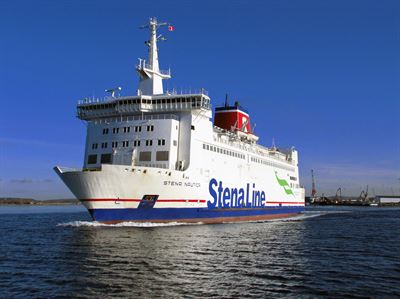
Stena Line will discontinue its Halmstad–Grenaa ferry route, with the Stena Nautica operating until 30 April 2026, after failing to achieve sustained profitability since opening the route in 2020. The Board decided to terminate cooperation with Hallands Hamnar and Grenå Port, citing strong competition from fixed bridges, a strained cost environment and weak demand; affected customers will be offered Frederikshavn–Gothenburg as an alternative. Management frames the closure as a strategic reallocation of investment to stronger routes while maintaining a Swedish network of six routes and 12 vessels (including the Wasaline-acquired Umeå–Vaasa service from Feb 2026).
Market structure: Closure removes one small-capacity ferry (Stena Nautica) and shifts passengers/cargo to alternative ferry and road routes; winners are larger, diversified Northern European logistics operators (e.g., DFDS.CO) and major ocean integrators (MAERSK‑B.CO) that can absorb incremental freight and exert price discipline. Losers are regional port operators and local tourism/passenger services around Halmstad/Grenaa; expect localized freight reallocation and potential 3–5% short‑term price rises on alternative ferry lanes as utilization jumps.
Risk assessment: Near term (days–weeks) risk is operational (crew redeployment, short congestion at Gothenburg/Frederikshavn); short term (months) risk includes weaker-than-expected demand if macro softens further and regulatory intervention (municipal subsidies) that could reintroduce capacity. Tail risks: EU/local state aid to re-open routes, a major accident diverting traffic, or a rapid bridge‑toll change could flip economics; monitor bridge tolls and weekly rollings of freight units for 60–120 days.
Trade implications: Direct actionable plays are overweight large, liquid logistics (DFDS.CO 1–2% position; MAERSK‑B.CO 0.5–1% defensive) and underweight/trim subscale regional port exposures (reduce >50% holdings in specific small‑cap port names). Use a limited options overlay (buy 3‑month DFDS 10% OTM call or call‑spread sized 0.5% portfolio) to capture upside if volumes reprice upward within 90 days.
Contrarian angles: Consensus underestimates redeployment value — Stena may redeploy vessel capacity to higher‑margin routes (improving group EPS), benefiting equity multiples of large competitors via network rationalization. Potential unintended consequence: increased trucking volumes could pressure local road logistics providers and create regulatory pushback (subsidies/emissions rules) that would reset economics within 6–18 months.
AI-powered research, real-time alerts, and portfolio analytics for institutional investors.
Request DemoOverall Sentiment
moderately negative
Sentiment Score
-0.40
