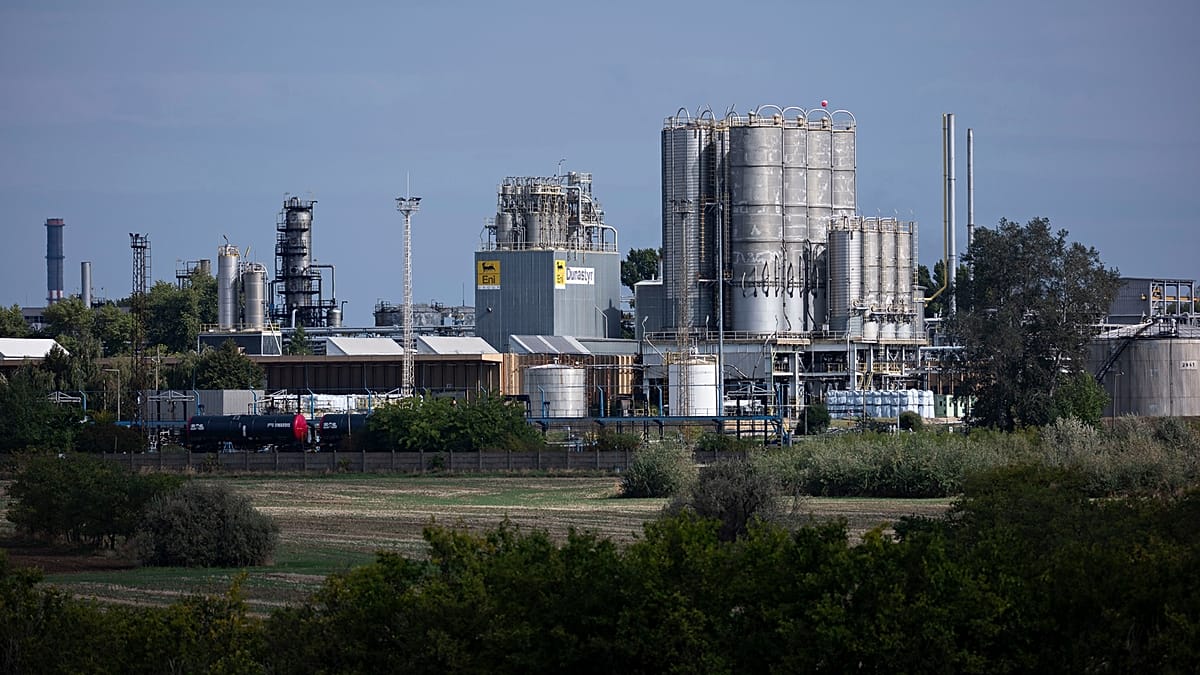
The European Commission has delayed a proposal to permanently ban Russian oil, increasing near-term policy uncertainty; Brent crude remains over $100 and fell from $112 to $102 (-$10, ~9%) after US-Iran developments. The postponement reflects Middle East-driven market shocks, US easing of sanctions on Russian oil, and a political standoff with Hungary and Slovakia over the Druzhba pipeline — a dispute that has paralysed a €90bn loan for Ukraine and could trigger legal challenges. The combination raises short-term EU energy security and price risks and is likely to keep oil markets volatile.
Policy uncertainty around a permanent EU oil ban is a live option that markets are mispricing: the value of that option is asymmetric because a permanent ban forces structural rerouting of marginal barrels rather than a temporary shock. Expect higher delivered costs to Europe driven not only by spot crude moves but by longer tanker voyages and re‑export arbitrage — conservatively adding $2–6/bbl to delivered prices for Central European refiners if Black Sea/Druzhba flows are sidelined for months.
The Hungary/Slovakia leverage over pipeline transit creates a political-economy choke point with outsized optionality on both finance and supply: the ability to stall disbursements (e.g., the €90bn loan) is effectively a bargaining chip that can delay infrastructure fixes for 3–9 months, keeping marginal supply tight into northern/central Europe through the winter. That creates a durable bifurcation between southern European importers (who can soak up seaborne barrels) and landlocked Central Europe, which faces persistent premium risk and capacity underinvestment.
Near-term catalysts are binary and fast: renewed shut-ins in the Strait of Hormuz or a spike in tanker insurance claims can lift Brent $15–30 within days; conversely, a credible diplomatic cooling between the US/Iran or a coordinated SPR release could erase that premium in 48–72 hours. Over 3–18 months the bigger players are infrastructure winners — terminals, FSRUs and longer-haul tanker owners — while refiners with flexible feedstock routes capture margin upside; demand destruction remains the main structural downside if prices persist above $100 for multiple quarters.
For portfolio construction this argues for convex, time‑limited exposure to oil upside and directional exposure that benefits from wider arbitrage/freight spreads rather than pure long crude. Hedging should prioritize tail protection for the 0–90 day window and option-like instruments for the 3–12 month policy resolution horizon.
AI-powered research, real-time alerts, and portfolio analytics for institutional investors.
Request DemoOverall Sentiment
moderately negative
Sentiment Score
-0.45
