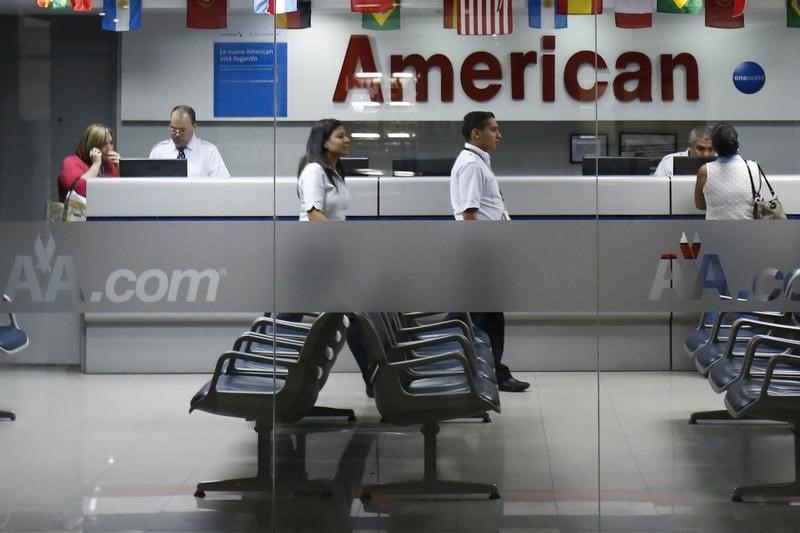
Raymond James reiterated a Market Perform rating on American Airlines, highlighting progress on margin improvement but also elevated earnings volatility, $34.9 billion of debt, and a weak 0.49 current ratio. The firm cut its Q2 2026 EPS estimate on lower revenue and higher non-fuel costs, while leaving 2026-2028 estimates mostly unchanged. Recent Q1 2026 results beat expectations with a $0.40 loss per share versus $0.47 expected and revenue of $13.91 billion versus $13.79 billion expected, but analyst sentiment remains cautious.
AAL is still in the “good news, bad balance sheet” phase of the cycle. The key second-order issue is that every incremental improvement in unit revenue is doing less for equity value than it would for peers because leverage turns operating upside into creditor de-risking first; that means the stock can screen cheap for a long time without rerating unless liquidity risk visibly recedes. In contrast, the better-capitalized network carriers can convert the same demand backdrop into more durable FCF and capacity optionality.
The market is likely underestimating how much management’s refusal to give a second-half capacity guide signals uncertainty about both fuel and fare elasticity, not just prudence. That creates a near-term setup where analysts keep trimming estimates while the tape remains hostage to oil and macro data over the next 4-8 weeks; airline equities tend to trade more on the slope of earnings revisions than on absolute valuation until the next guide. If fuel stays stable and pricing holds, AAL has room for a sharp reflexive rally, but if non-fuel costs stay sticky, the equity remains vulnerable to another leg lower because the leverage math leaves little cushion.
The contrarian angle is that the stock may be closer to a tradeable bottom than a fundamental inflection. With sentiment already washed out and consensus estimates still being reset, any confirmation of margin improvement from fee mix and buy-up could trigger a short-covering move in the 1-2 month window. However, the more durable relative winner is likely DAL, whose cleaner balance sheet and stronger pricing power should allow it to capture the same industry demand tailwind with less equity beta and less financing risk.
INTC is only a peripheral beneficiary here via the broader risk-on tape; the airline read-through is more about cyclical confirmation than direct exposure. If investors want to express the constructive demand view, the better risk-adjusted expression is not a naked long in AAL but a relative-value trade versus a higher-quality peer or an options structure that limits downside if fuel or macro turns quickly.
AI-powered research, real-time alerts, and portfolio analytics for institutional investors.
Request TrialOverall Sentiment
neutral
Sentiment Score
-0.05
Ticker Sentiment
