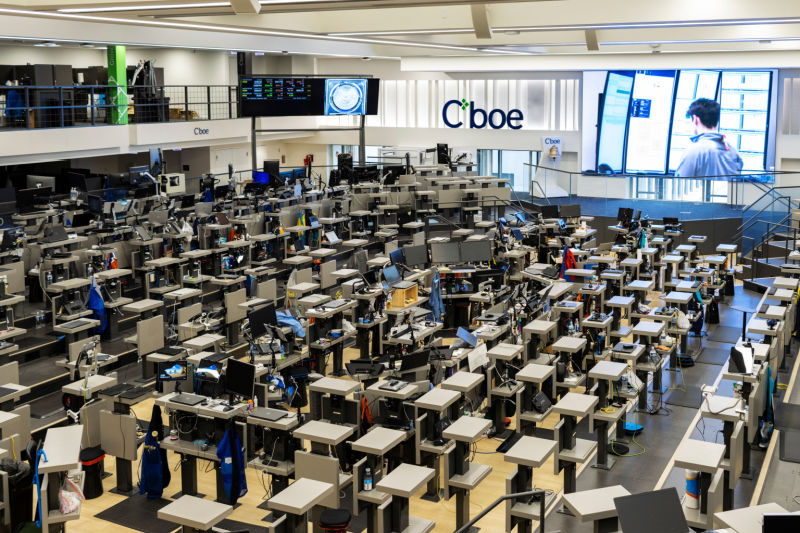
Cboe Global Markets declared a quarterly dividend of $0.72 per share for Q2 2026, payable June 15 to shareholders of record on May 29, underscoring ongoing capital returns. The company also reported Q1 2026 EPS of $3.70 versus $3.25 expected and revenue of $728.9 million versus $693.75 million expected, a solid beat. The news is broadly positive for CBOE, though the article is mostly routine company update and analyst commentary rather than a market-moving catalyst.
CBOE reads as a quality compounder where the market often underprices the value of volatility monetization plus capital returns. In a tape where cross-asset uncertainty is staying elevated, the business can improve even without a directional equity bull market because its revenue mix benefits from higher hedging demand, not just higher spot volumes. The raised payout is also a signal that management sees cash generation as durable; that matters because it can support a rerating if investors start treating CBOE less like a cyclical exchange and more like a cash-yielding infrastructure asset. The second-order winner is not just CBOE’s own equity holders, but other market-structure names with recurring fee streams: BGC can get a sympathy bid if investors re-anchor on secular growth in electronic execution and market data. The risk is that strong earnings and dividend optics invite complacency; if implied volatility compresses for several weeks, the stock can stall despite fundamental strength, because the next leg higher likely needs either another earnings beat or a sharper spike in listed-derivatives activity. The contrarian angle is that the market may be extrapolating too much from a clean quarter into a steady-state multiple expansion. Exchange names often look expensive until the regime changes, and here the real question is whether the current environment sustains elevated activity over the next 2-3 quarters or mean-reverts as macro uncertainty fades. If rates volatility cools and equities grind higher, the multiple could compress even while fundamentals remain solid, making entry timing more important than the long thesis itself.
AI-powered research, real-time alerts, and portfolio analytics for institutional investors.
Overall Sentiment
mildly positive
Sentiment Score
0.35
Ticker Sentiment
