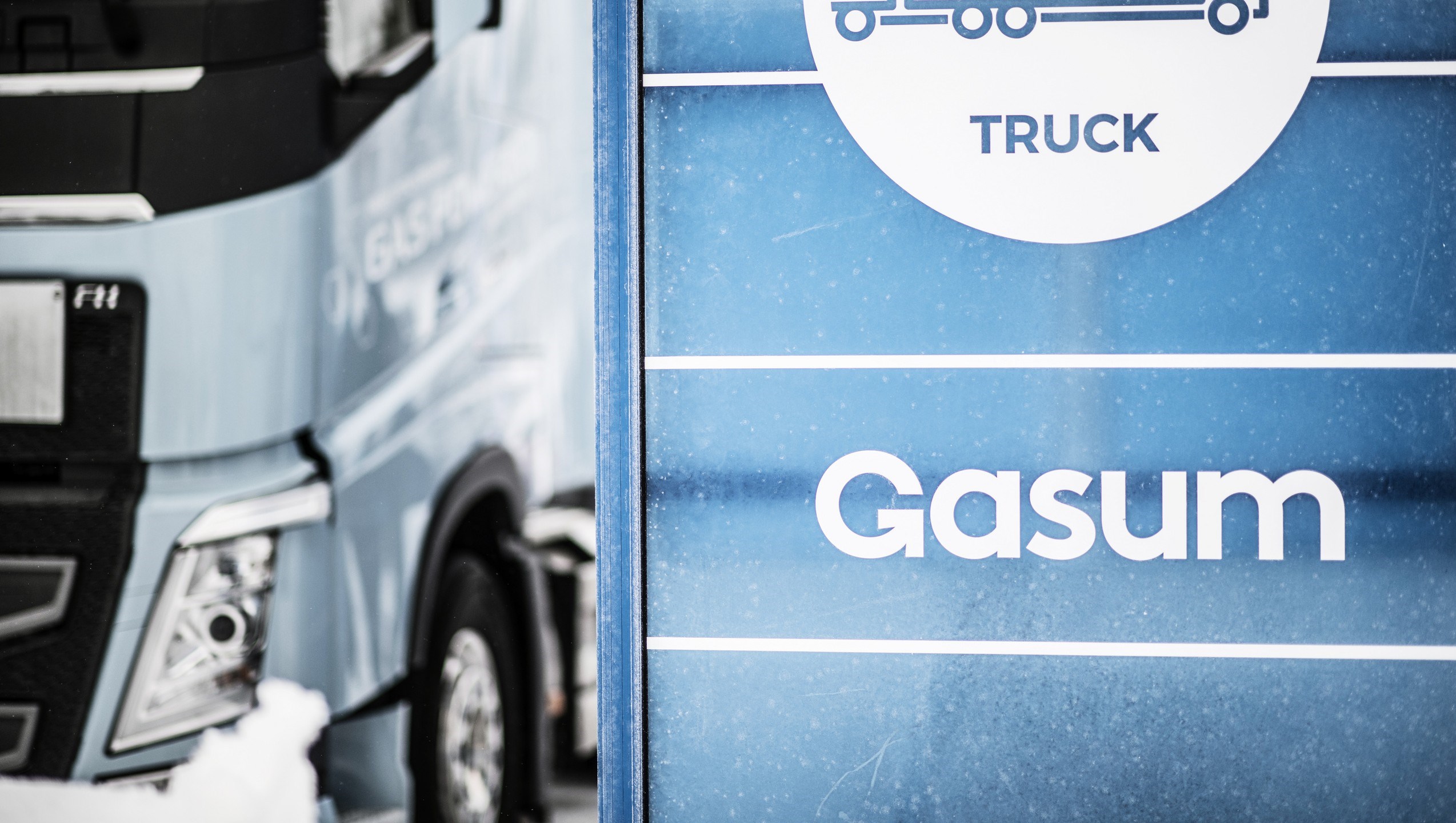
Gasum has opened a new liquefied biogas (LBG) heavy-vehicle filling station in Ylivieska, Finland (Ouluntie 25), positioned on key national transport routes and adjacent to a DSV terminal to support freight traffic decarbonisation. DSV, which after its 2025 merger with Schenker employs nearly 150,000 people globally and 1,800 in Finland, will station a new biogas truck there and currently operates 26 LBG and three CBG vehicles in Finland; gas trucks comprised roughly 8% of newly registered heavy-duty vehicles in Finland in 2025. The expansion modestly strengthens Gasum's distribution footprint and could incrementally boost biogas demand in Nordic land and sea logistics as Gasum ramps its own production and supplier procurement.
Market structure: Gasum's new LBG station tightens the Nordic refuelling network, favoring logistics companies with fleet conversion plans (DSV) and suppliers of cryogenic/tank technology. Expect incremental demand for LBG infrastructure equipment (Hexagon, Chart) to grow faster than vehicle OEM revenues in the near term because station rollout addresses range anxiety — gas-truck share was ~8% in 2025 and could plausibly double in Nordic long‑haul segments by 2028. Downstream refiners/fossil diesel demand face gradual volume erosion; crude price impact is muted but feedstock and biomethane spreads may widen.
Risk assessment: Tail risks include abrupt subsidy removal, methane regulation raising compliance costs, or rapid battery/H₂ breakthroughs that make LBG obsolete; any of these could swing valuations >25% for niche suppliers. Immediate (days) impact is minimal; short-term (weeks–months) catalysts are station announcements and fleet purchase orders; long-term (quarters–years) depends on feedstock availability and certification regimes. Hidden dependencies: biogas supply chains (waste feedstock, capex for digesters) and cross-border refuelling regulations could bottleneck utilization.
Trade implications: Direct plays: favor DSV (logistics contracting premium) and infrastructure names that make tanks/cryogenics (HEX.OL, NASDAQ:GTLS). Use pair trades to isolate technology risk (long Hexagon, short heavy OEM exposure like VOLV-B.ST). Options: 9–12 month call spreads on HEX.OL/GTLS to express volume growth while limiting premium; buy short-dated puts on DSV as downside insurance ahead of Q reports. Rotate portfolio away from diesel-focused refiners by 2–5% into green-infra and logistics names within 4–8 weeks.
Contrarian angles: Consensus treats this as incremental PR; miss is network effects — each additional station can nonlinearly unlock fleet conversion in a 100–200 km corridor, amplifying equipment demand. Reaction is underdone for suppliers and modestly overdone for pure-play truck OEMs that will face both new adoption cycles and price competition. Historical parallel: LNG truck rollouts in 2015–18 show multi-year demand tailwind for tank/cryogenic vendors even when vehicle OEM adoption lagged. Unintended consequence: rapid station growth without secured biogas volumes could create stranded assets and pressure margins for early-stage producers.
AI-powered research, real-time alerts, and portfolio analytics for institutional investors.
Request DemoOverall Sentiment
mildly positive
Sentiment Score
0.35
