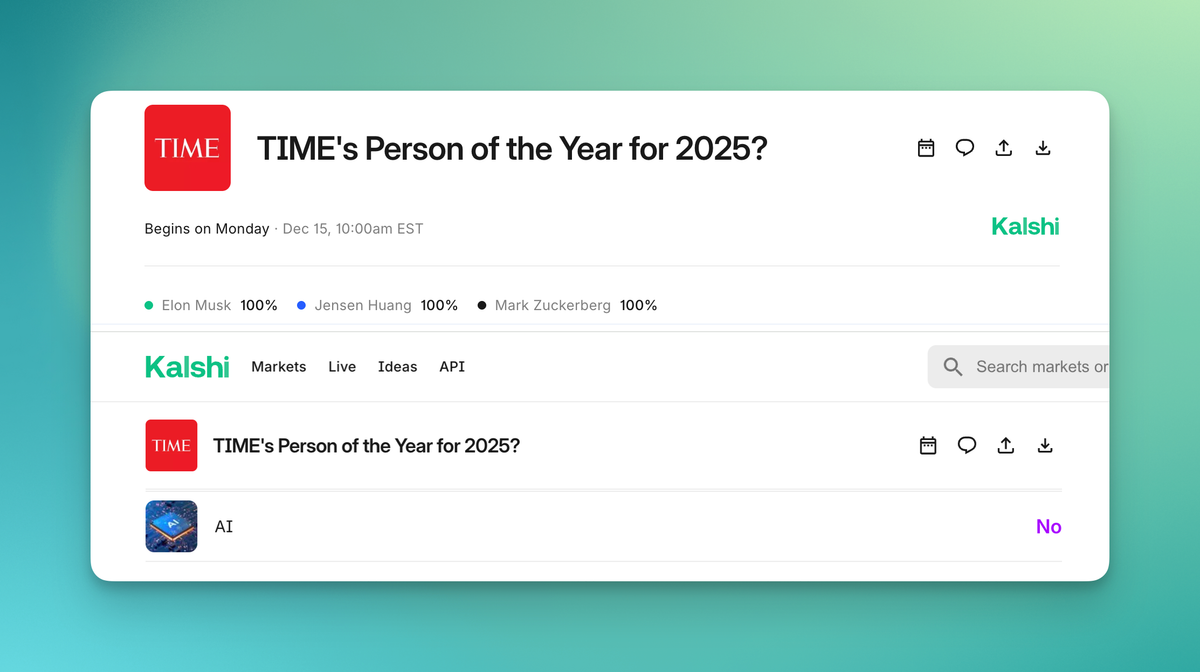
Time magazine named the “Architects of AI” its 2025 Person of the Year, triggering disputes on prediction markets after bettors who backed “AI” or specific candidates found their positions resolved differently: Polymarket ruled that the cover’s phrasing did not qualify as “AI” and paid out narrowly under its person/thing naming rules, while Kalshi paid winners who backed named individuals (Altman, Musk, Huang, etc.) but not product names like ChatGPT. The controversy has financial stakes—more than $6m was wagered on “AI” on Polymarket, with the platforms hosting roughly $55m and $19m in Time-Person-of-the-Year markets respectively—and highlights material operational and contract-definition risk in prediction markets. Recent incidents (unauthorized map edits, a trader making $1m in 24 hours, disputed resolutions) underscore vulnerability to manipulation and reputational/legal risk as these venues scale and integrate with mainstream media, a consideration for investors and counterparties exposed to them.
Time magazine named “Architects of AI” its 2025 Person of the Year, triggering contested outcomes on prediction markets after bettors who backed the label “AI” or individual names found positions resolved differently. Polymarket, which saw more than $55 million wagered across its Time markets and more than $6 million specifically on “AI,” applied a strict “person/thing named” rule that excluded the cover phrase and paid “Other,” while Kalshi (~$19 million in Time bets) paid winners who backed named individuals (Altman, Musk, Huang, et al.) but not product names like ChatGPT. User ire is substantive and public, with multiple complaints and calls for refunds documented in the article.
The dispute amplifies operational and contract-definition risk for prediction markets and highlights recent integrity incidents: an unauthorized Ukraine map edit that allowed false cashouts, a trader reportedly making $1 million in 24 hours on Google’s Year in Search bets, and other contested resolutions such as Zelenskyy’s attire. These episodes illustrate persistent vulnerabilities to manipulation, governance ambiguity, and reputational/legal exposure as such platforms seek mainstream integrations (the article cites potential ties with outlets like CNN). The provided sentiment signal is moderately negative (−0.45) with low market-impact scoring (0.3), implying reputational damage exceeds immediate systemic market contagion.
For investors, the core takeaway is that dispute-resolution mechanics materially affect realized payoffs and platform credibility; ambiguous contract language can reverse apparent outcomes and create refund/liability risk. Expect heightened regulatory and counterparty diligence demands, potential short-term volume volatility, and a need to treat prediction-market operators as governance-risk investments rather than pure growth plays.
AI-powered research, real-time alerts, and portfolio analytics for institutional investors.
Request DemoOverall Sentiment
moderately negative
Sentiment Score
-0.45
Ticker Sentiment
