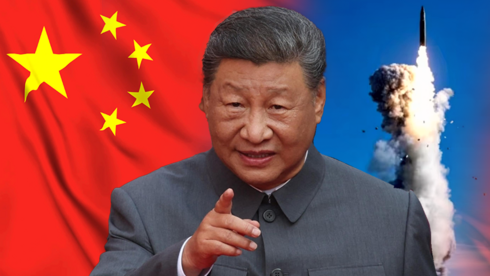
China has dramatically accelerated military modernization under Xi—doubling its declared nuclear warheads from roughly 300 to 600 in five years (Pentagon estimates China could exceed 1,000 by 2030), officially spending about $245bn a year on defense while expanding missile production ~50% and enlarging 60% of 136 missile facilities (adding ~2m sq. meters); Beijing unveiled a nascent nuclear triad and advanced systems (MIRVed DF‑5C ICBMs, hypersonic glide vehicles, robotic submarines) and is rapidly growing a blue‑water navy (332 ships vs. the U.S. Navy’s 291 in 2023, CSIS projects a 48% fleet increase by 2030) including the domestically built Fujian carrier. U.S. intelligence sees China preparing options for a Taiwan operation as early as 2027, but PLA readiness is clouded by large anti‑corruption purges and reported maintenance shortfalls; China’s doctrine favors missile barrages and blockades rather than risky amphibious landings. Strategic consequences are acute for investors and policymakers: waning U.S. deterrence under an ambiguous Trump posture and a reported U.S. pivot toward homeland defense risk reducing forward security guarantees, likely prompting higher regional defense spending, supply‑chain and defense‑industry demand shifts, and persistent geopolitical volatility across Asian markets.
China has accelerated a wide-ranging military modernization campaign under Xi Jinping that the article quantifies: declared nuclear warheads doubled from roughly 300 to 600 in five years with Pentagon estimates exceeding 1,000 by 2030, an official defense budget of about $245 billion annually, a 50% acceleration in missile production, and expansion of more than 60% of 136 missile production sites adding roughly 2 million square meters. Beijing publicly displayed a nascent nuclear triad (MIRVed DF-5C ICBMs, hypersonic glide vehicles), robotic submarines and the domestically built Fujian carrier, while the PLAN already numbered 332 vessels versus the U.S. Navy’s 291 in 2023 and is projected by CSIS to grow ~48% by 2030.
Operational readiness is ambiguous: large anti-corruption purges (at least 14 of 79 promoted generals removed, including the Rocket Force commander), Bloomberg-cited maintenance shortfalls and anecdotal claims of degraded missiles raise reliability and command-effectiveness questions that could delay or shape Beijing’s use-of-force calculus. Concurrently, U.S. policy ambiguity under President Trump and a reported pivot of U.S. forces toward homeland defense increase strategic uncertainty in the Indo-Pacific and may reduce predictable forward deterrence.
For markets, the story implies sustained geopolitical risk, higher regional defense procurement and supply-chain realignments benefiting missile, naval and advanced-sensor suppliers, alongside acute event risk to Asian equities and trade-sensitive sectors if tensions escalate toward blockade or limited conflict scenarios.
AI-powered research, real-time alerts, and portfolio analytics for institutional investors.
Request DemoOverall Sentiment
strongly negative
Sentiment Score
-0.65
Ticker Sentiment
