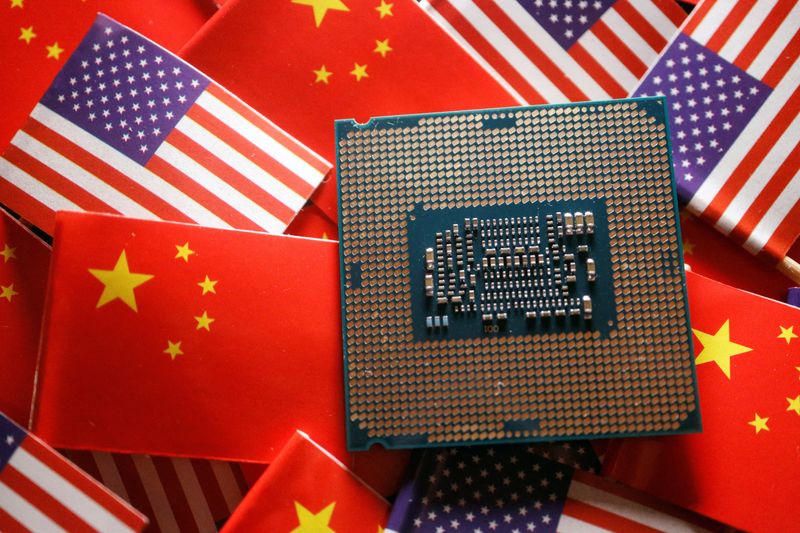
The U.S. and China are reportedly considering official talks on artificial intelligence, with the topic possibly added to a Trump-Xi summit in Beijing next week. Key issues include AI model safety, autonomous military systems, and AI-enabled cyberattacks, with Treasury Secretary Scott Bessent expected to lead the U.S. side. The report is more policy- and risk-focused than market-moving, though it reinforces scrutiny of AI, cybersecurity, and defense applications.
This is less about a near-term diplomatic headline and more about the market pricing a lower tail-risk regime. If even exploratory U.S.-China talks on AI proceed, the immediate winner is infrastructure: both sides will likely prioritize compute controls, model oversight, and cyber attribution, which tends to increase demand for monitoring, compliance, and hardened systems rather than frontier-model upside. That makes the best risk-adjusted exposure in the AI stack likely to be picks-and-shovels names with strong enterprise attachment, not the most speculative model builders.
The second-order effect is regulatory bifurcation. A bilateral AI framework would probably not reduce competition; it would formalize boundaries around autonomous weapons and offensive cyber, pushing spend toward defensive AI, sovereign cloud, and domestic supply-chain localization. That is constructive for cybersecurity and infrastructure vendors, while creating a subtle headwind for companies whose valuation depends on unconstrained model release velocity or cross-border monetization.
For the two highlighted names, the setup is more nuanced than simple AI-beta. SMCI benefits only if the market believes accelerated capex continues; any AI safety rhetoric that shifts budgets from training expansion to governance, inference efficiency, or internal controls can compress the multiple on hardware-heavy beneficiaries. APP is more insulated if ad-tech spend stays healthy, but the market may still use it as a high-beta proxy; the upside is more about sentiment than direct policy exposure. Contrarian takeaway: the consensus may be overestimating the importance of the summit itself and underestimating the medium-term boost to cybersecurity and compliant infrastructure spend.
Catalyst risk is asymmetric: a failed summit or a sharp deterioration in U.S.-China relations would quickly unwind this theme, while any real policy coordination likely matters over months, not days. The market is likely to front-run headline optimism faster than the underlying budget shifts, so chasing the first move is less attractive than positioning for a rotation within AI exposure.
AI-powered research, real-time alerts, and portfolio analytics for institutional investors.
Request DemoOverall Sentiment
neutral
Sentiment Score
0.05
Ticker Sentiment
