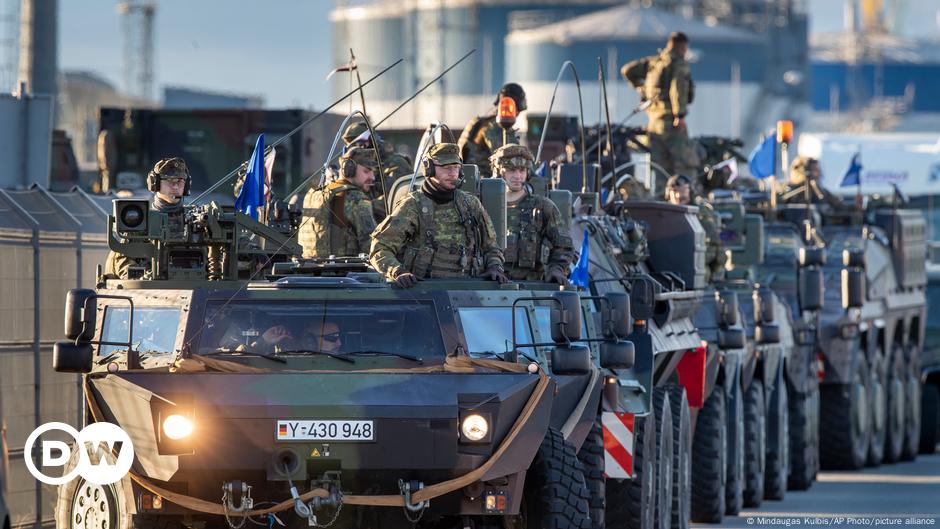
Several key developments emerged from Germany today, including the launch of its first permanent overseas military deployment in Lithuania, aimed at deterring potential Russian aggression on NATO's eastern flank. Chancellor Merz supports increasing NATO defense spending, echoing calls from Secretary-General Rutte and previously President Trump, with Lithuania planning to increase spending to over 5% of GDP next year. Economically, Finance Minister Klingbeil announced an 'investment booster' to revive the German economy, allowing companies to write off up to 30% of investments, while the Ifo business climate index improved, signaling a slow recovery.
Germany is signaling a significant strategic pivot, highlighted by the launch of its first permanent overseas military brigade in Lithuania aimed at bolstering NATO's eastern flank against potential Russian aggression. Chancellor Friedrich Merz has endorsed higher NATO defense spending, aligning with proposals for members to allocate 3.5% of GDP to defense and an additional 1.5% to related infrastructure, with Germany's own defense expenditure rising to 2.12% of GDP in 2023 from 1.19% in 2014, facilitated by an easing of its 'debt brake.' Concurrently, addressing domestic economic concerns, Finance Minister Lars Klingbeil announced an 'investment booster' program, allowing companies to write off up to 30% of investments to stimulate private sector activity and public spending. This initiative aligns with a modest improvement in business sentiment, as the Ifo business climate index rose to 87.5 in May from 86.9 in April, primarily driven by a 1.5 point increase in corporate expectations to 88.9, suggesting a gradual economic recuperation despite current conditions assessments dipping slightly by 0.3 points to 86.1. The broader environment also includes a shift in Germany's stance on nuclear energy within EU taxonomy, with Economy Minister Katherina Reiche defending its classification as sustainable, although Germany does not plan to revive domestic nuclear power.
AI-powered research, real-time alerts, and portfolio analytics for institutional investors.
Request DemoOverall Sentiment
Positive
Sentiment Score
0.45
