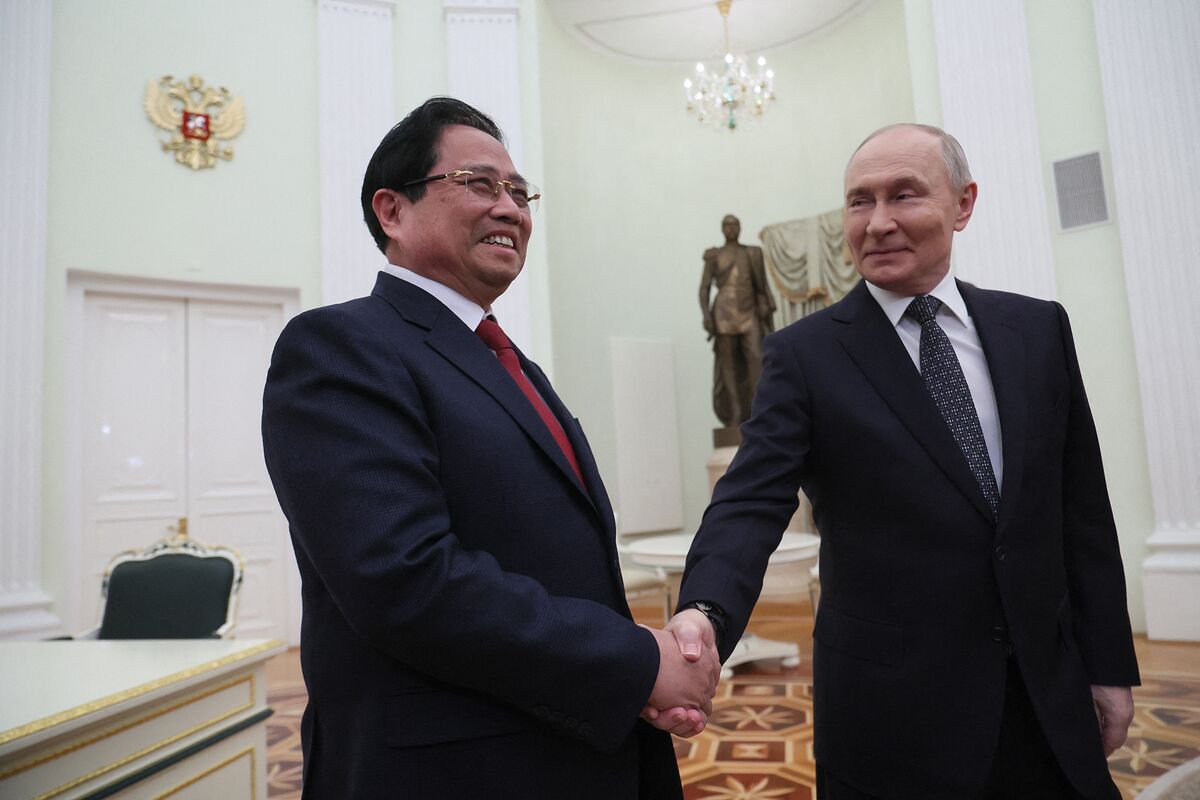
Putin accepted an invitation to visit Vietnam (reported as 2026) during talks with Vietnamese Prime Minister Pham Minh Chinh, emphasizing a close, friendly bilateral relationship. The announcement is political/diplomatic and unlikely to have immediate market effects, though it may modestly support future economic or trade cooperation between Russia and Vietnam.
Diplomatic warming between Moscow and a Southeast Asian manufacturing hub is less a single headline than a slow-moving catalyst that can reshape trade routes, sanctions arbitrage channels, and defense procurement over 6–36 months. Expect modest but measurable changes: if Moscow secures logistics or transshipment advantages via friendly ports, a non-trivial share (we estimate 5–15%) of Russian fertilizer/energy flows currently constrained by Western routing could be redirected through the region, lowering short‑term regional price volatility and creating arbitrage opportunities for traders.
For local corporates, the mechanical effect is twofold — cheaper energy/fertilizer or preferential commodity access can nudge manufacturing margins by a few hundred basis points over 12–24 months for energy‑intensive exporters, while elevated political alignment raises tail risk of secondary sanctions that would compress valuations quickly. We assign a 10–25% probability over two years of at least one US/EU measure that meaningfully limits Vietnamese access to specific Western capital or technology, which would disproportionately punish highly leveraged or internationally dependent names.
Regionally, a deeper security relationship amplifies defense spending and naval logistics demand across ASEAN; that benefits defense primes with Asian order books and ship/port services, whereas global shipping insurers and commodity traders face episodic risk premia increases (P&I, war‑risk) if tensions spike. Key reversals would be rapid US diplomatic offsetting (incentives/counter‑deals) or Moscow internal constraints — both could unwind any short-term commercial flows within months, making moves tactical rather than structural for most allocators.
AI-powered research, real-time alerts, and portfolio analytics for institutional investors.
Request DemoOverall Sentiment
neutral
Sentiment Score
0.00
