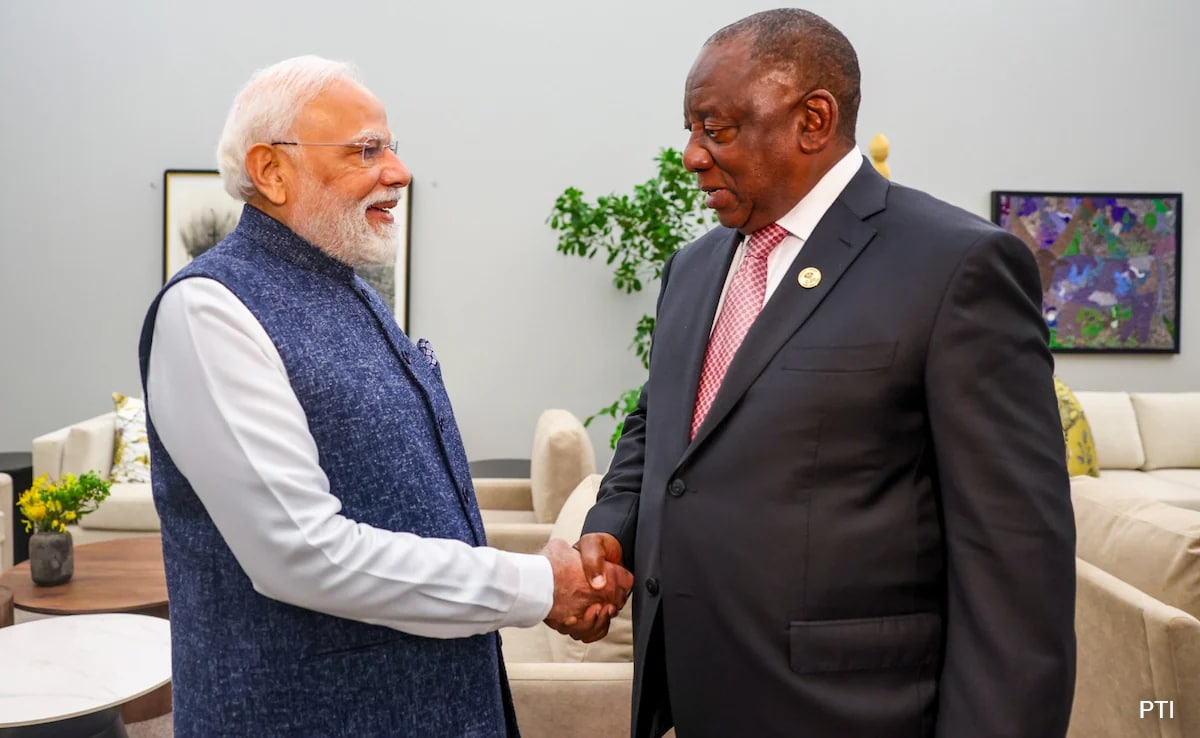
South African President Cyril Ramaphosa, in bilateral talks with Prime Minister Narendra Modi, thanked India for its support and guidance as South Africa prepares to host the first G20 leaders' summit on African soil, noting lessons learned from India's 2023 hosting at Bharat Mandapam. The cordial exchange — including a light-hearted remark about the difficulty of hosting — and reference to the African Union's accession to the G20 under India's presidency signal diplomatic cooperation and elevated international engagement for South Africa but carry minimal direct market or policy implications.
Market structure: South Africa hosting a high-profile summit lifts demand for short-term local assets (FX, hospitality, domestic equities) and raises visibility for sovereign credit and large-cap exporters. Expect transient inflows concentrated in ETF/ADR instruments and JSE large caps; incremental pricing power for local travel/hospitality contractors may lift near-term revenues by low double-digits in the summit quarter but not structural GDP.
Risk assessment: Tail risks include large-scale protests or a security incident that could reverse flows, widen sovereign spreads by 100–300bps, and trigger risk-off selling in ZAR and EZA within days. Immediate window risk is days-to-weeks; short-term catalysts are contract awards and pre-summit infrastructure spend (weeks–months); long-term effects (quarters) hinge on whether African Union accession materially increases trade liberalization or capital flows.
Trade implications: Tactical, low-duration plays capture the event: short-term long exposure to EZA and liquid SA ADRs, tactical ZAR carry/long on 1–3 month tenor, and buy downside protection sized to 0.5–1% of book to guard against protest/downgrade scenarios. Cross-asset: expect modest tightening in 2–10yr SA sovereign spreads if summit goes smoothly, and 4–8% ZAR appreciation potential into the event window.
Contrarian: Consensus underprices reputational upside — successful hosting could sustainably lower perceived execution risk and compress ZAR risk premia by 50–100bps over 6–12 months; conversely, markets underweight the probability (10–15%) of a reputational shock that would force outsized spread widening. Position sizing should be asymmetric: small, optioned longs with defined downside and convex upside.
AI-powered research, real-time alerts, and portfolio analytics for institutional investors.
Request DemoOverall Sentiment
neutral
Sentiment Score
0.05
