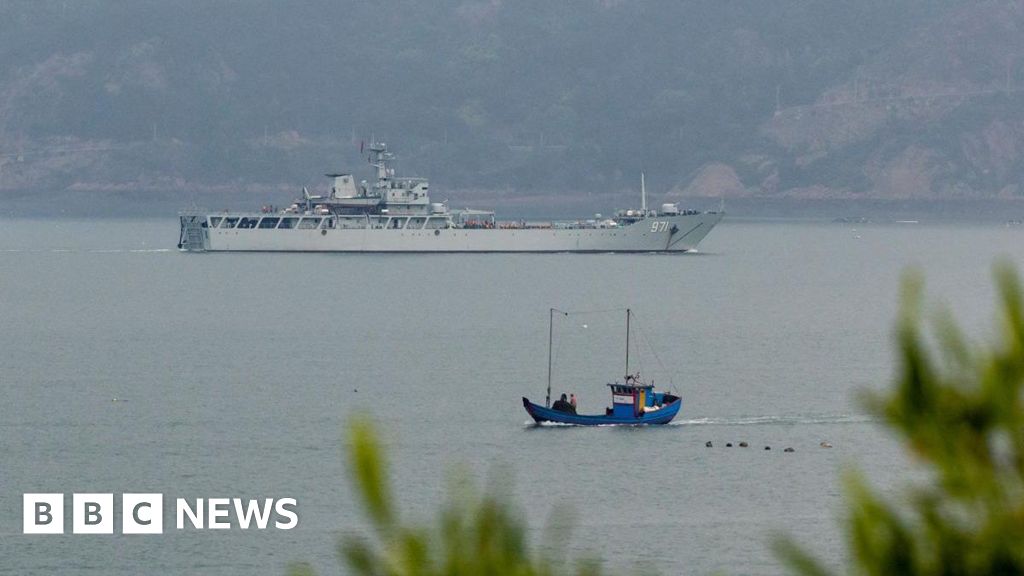
China announced multi-branch live-fire military drills around Taiwan codenamed "Justice Mission 2025" — simulating seizure and blockade of key areas — days after the US approved an $11bn weapons package for Taiwan and Beijing imposed sanctions on US defence firms. Taiwan has detected Chinese aircraft and ships, deployed missile systems and placed forces on high alert; the escalation raises near-term geopolitical risk for Asian markets, defense contractors, regional trade/FX flows and investor positioning, warranting close monitoring of Taiwan-, Japan- and China-exposed assets.
Market structure: Near-term winners are US and allied defense primes (Lockheed LMT, Raytheon RTX, Northrop NOC) and specialty munitions/ISR suppliers as governments accelerate procurement; losers are Taiwan equity exposure (EWT) and China-exposed travel/consumer names if drills become protracted. Pricing power shifts to large defense OEMs and niche component suppliers (radars, missiles, electronic warfare); semiconductor tool suppliers (ASML, LRCX) face short-term demand re-routing but retain long-term pricing leverage. Cross-asset signals: expect immediate risk-off flows into USTs and gold (yields down, gold up), JPY/ USD strength; oil upside if shipping lanes are constrained (>48 hrs). Equity implied vol in TW/China ADRs likely to spike 15–30% intraday.
Risk assessment: Tail risks include a temporary maritime blockade or limited kinetic strikes (low probability near-term 1–5% but extreme impact), US-China military clash (sub-1% but systemic), and expanded sanctions disrupting component supplies to Chinese defense firms. Timeline: days — volatility and flows; weeks–months — procurement contracts and sanctions materialize; 6–24 months — structural supply-chain re-shoring and defense capex. Hidden dependencies: fab-equipment bottlenecks (ASML export controls), insurance/GLP for shipping, and Japanese security posture shifts that can amplify sanctions. Key catalysts: confirmed port/airspace closures >48 hrs, US arms-sale implementations, Japan shifts in SDF policy.
Trade implications: Direct plays — establish modest long defense positions (2–4% portfolio) and buy 3-month ATM puts on EWT (1–2% notional) as a hedge; increase safe-haven duration (TLT) and GLD allocation by 1–2% each. Options — prefer cost-limited structures: 3-month EWT put spreads (buy 1, sell lower strike) and 6–12 month LMT/RTX call spreads to capture contract awards while capping premium. Sector rotation: trim EM Asia cyclical and travel (2–5% reallocation) into defense, infrastructure and energy; enter in tranches over 2–6 weeks, tighten stops if escalation subsides.
Contrarian angles: The market may overstate permanent decoupling — historical parallels (1996 Strait tensions) show swift policy responses but limited long-term market damage; a 10–20% selloff in high-quality Taiwan semis (TSM, ASML exposure names) could create buying opportunities for secular demand in AI/auto. Also, stronger Chinese drills may accelerate US/Taiwan procurement, boosting US primes' revenue 5–15% over 12–24 months — a domestically biased “sanctions-to-sales” feedback loop investors may be underweight.
AI-powered research, real-time alerts, and portfolio analytics for institutional investors.
Request DemoOverall Sentiment
moderately negative
Sentiment Score
-0.40
Ticker Sentiment
