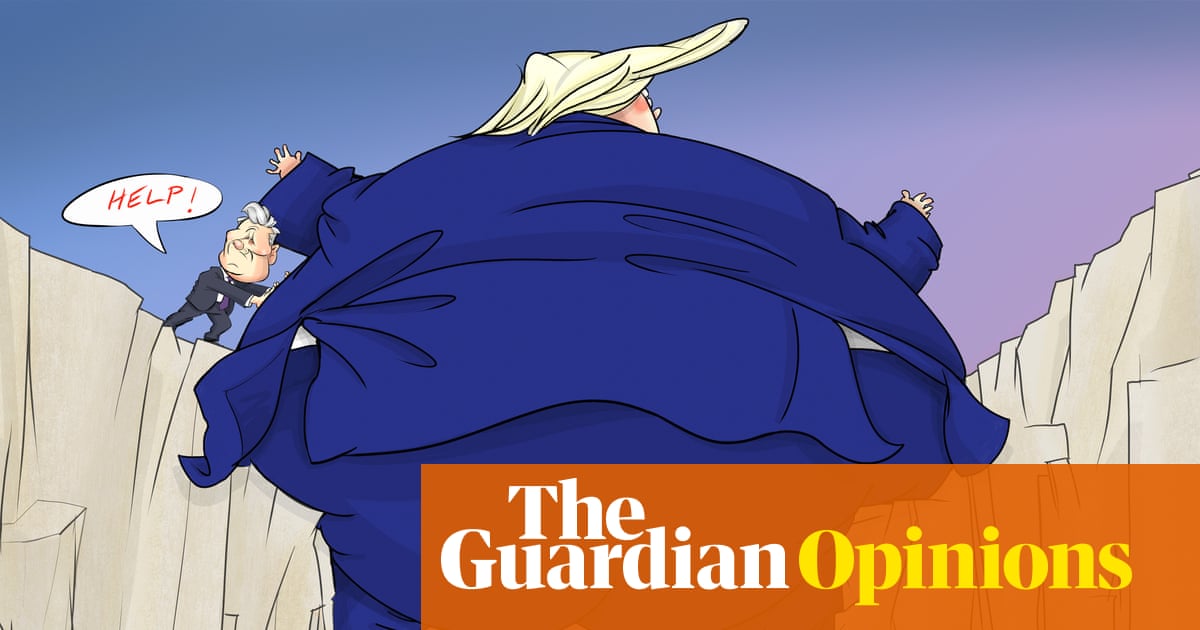
This is a Guardian opinion cartoon by Nicola Jennings linking Donald Trump to tensions in the Strait of Hormuz and broader Middle East risks amid mentions of US-Israel conflict with Iran. The piece is editorial/illustrative rather than reporting new facts, so it carries negligible direct market impact but highlights political risk that could matter for energy shipping through the Hormuz.
Hawkish rhetoric around the Strait of Hormuz functions as a high-frequency volatility amplifier rather than a permanent supply shock: a localized incident or temporary closure can drive a 5–15% crude bump within days via immediate risk premia and war‑risk insurance, but physical supply response (SPR releases, OPEC spare capacity, US shale reactivation) can neutralize most of that premium within 3–6 months. Shipping economics are the hidden lever — rerouting around the Cape of Good Hope adds roughly 6–12 days and 1,000–2,500 nm to VLCC voyages, increasing bunker burn and charter earnings on spot tanker names while shortening effective refinery feedstock flow and raising delivered fuel costs for importers. These mechanics create asymmetric windows: short-term winners are owners of flexible tanker capacity and war-risk underwriters; medium-term winners are producers with low incremental lifting costs and idle takeaway flexibility, while integrated refiners and logistics-dependent exporters are vulnerable to margin compression.
Political signals matter to market pricing beyond the physical: election-driven escalation (weeks–months horizon) raises the probability of episodic shocks, while rapid de‑escalation through backchannels collapses premiums almost immediately. Tail risks — a sustained blockade or a strike on export infrastructure — remain low-probability but high-impact (months-long outages with >$15/bbl upside); conversely, a diplomatic détente or coordinated SPR release is the primary reversal catalyst and can shave 8–12% off the oil risk premium within 48–72 hours. Media amplification and framing (cartoons, cable cycles) lengthen market attention and thus the persistence of the premium; that favors short‑dated volatility plays over long-duration commodity directional exposure.
AI-powered research, real-time alerts, and portfolio analytics for institutional investors.
Request DemoOverall Sentiment
neutral
Sentiment Score
0.00
