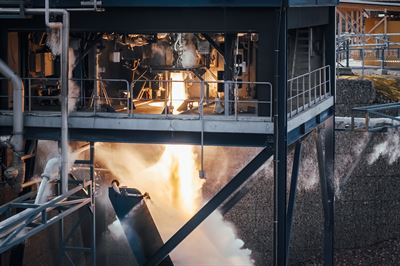
Isar Aerospace has opened a second, purpose-built test facility at SSC Space’s Esrange Space Center in Sweden to support its Spectrum rocket program, enabling testing of more than 30 engines per month and fully integrated stage acceptance testing. The expanded capacity is intended to accelerate development and production timelines and increase flexibility to meet growing launch demand, reflecting deeper operational vertical integration and a strengthened partnership with SSC Space. The move de-risks production scale-up for the privately funded, Munich-headquartered company (founded 2018, ~400 employees) and could improve time-to-market for its small- and medium-satellite launch services.
Market structure: The Isar–SSC expansion is a capacity shock for European small/medium-launch supply — testing capacity to “30+ engines/month” implies the ability to field multiple weekly launches within 12–24 months if production follows. Winners: verticalized launch OEMs, ground‑station operators and smallsat manufacturers (higher launch availability lowers lead times). Losers: high‑cost legacy launchers and any providers relying on scarcity premium; expect incremental downward pressure on per‑kg pricing for rides and dedicated small-launch services (mid-single‑digit % annual price compression if supply outpaces demand).
Risk assessment: Tail risks include a catastrophic test failure (engine or stage loss) triggering 3–9 month regulatory pauses and insurance rate spikes; capital markets tightening could slow private funding, delaying production by 6–18 months. Immediate market impact is negligible (days); watch 1–6 month operational readouts and 12–36 month commercial launch cadence for material revenue signals. Hidden dependency: Esrange scheduling/permits and SSC’s capacity allocation to other customers — shared infrastructure risk can bottleneck throughput despite hardware readiness.
Trade implications: Direct plays — allocate tactical exposure to space/theme ETFs (ARKX, UFO) and select suppliers with government/ground‑station revenue (MAXR, LHX) for a 12‑18 month horizon. Options — use 9–15 month call spreads on MAXR or LHX to cap premium and capture asymmetric upside if cadence accelerates; size 1–2% notional. Pair trade — long ARKX (1.5–2%) vs short BA (0.5–1%) to favor newspace growth over legacy aerospace, trim if ARKX outperforms +30% or BA outperforms +15%.
Contrarian angles: Consensus will celebrate capacity buildouts but underestimates margin pressure from accelerated supply — early entrants may face price competition and higher insurance/regulatory costs. Mispricing: ground‑station and mission ops are underappreciated beneficiaries (buy IRDM, MAXR) as launch frequency rises. Unintended consequence: higher launch cadence increases debris/insurance risk which could compress small‑launcher economics in years 2–4; set unwind triggers tied to regulatory/insurance rate moves >20% within 6 months.
AI-powered research, real-time alerts, and portfolio analytics for institutional investors.
Request DemoOverall Sentiment
mildly positive
Sentiment Score
0.34
