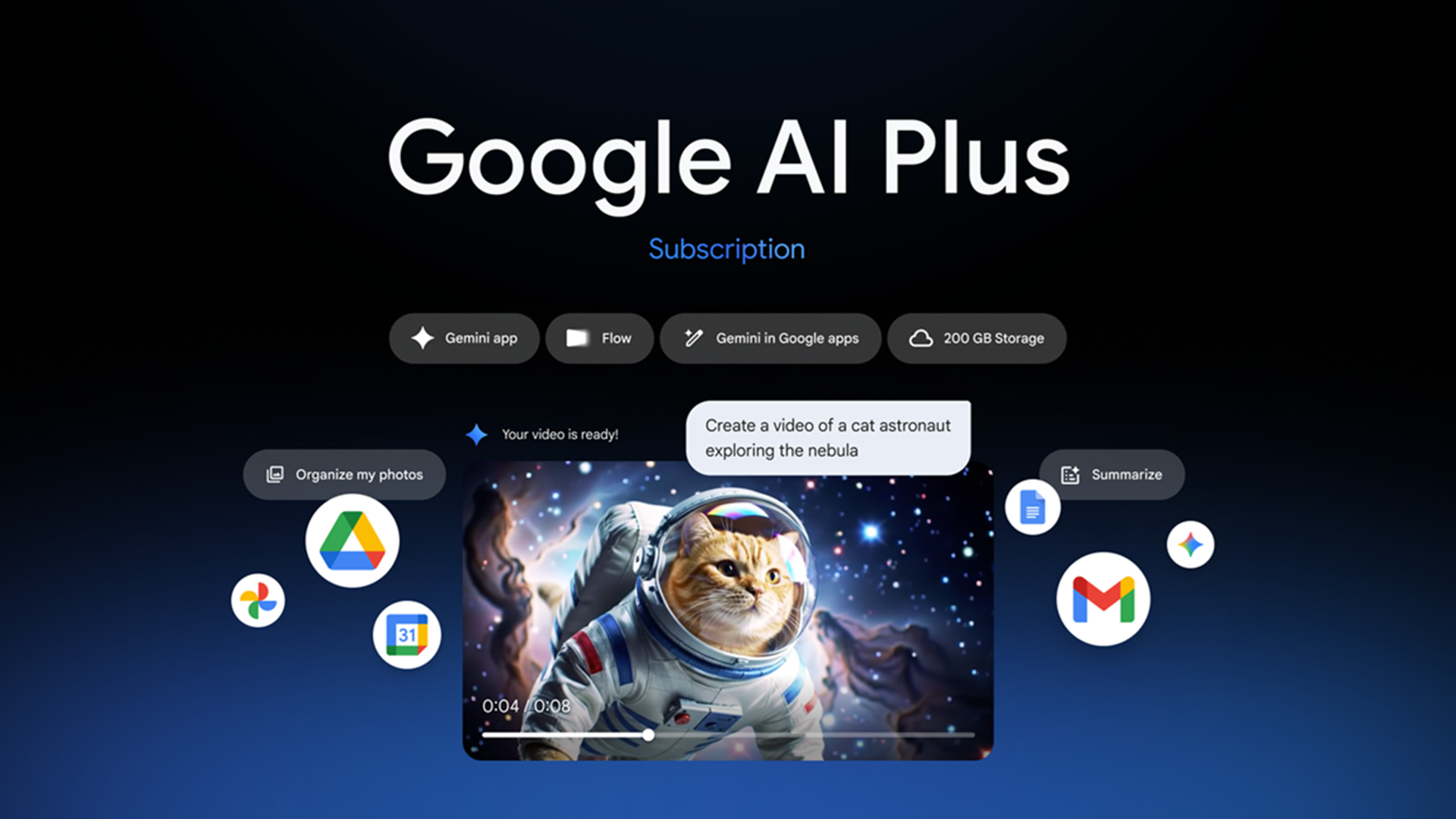
Google launched AI Plus in the U.S. and 34 other countries as a mid-tier AI subscription priced at $8/month (introductory $4/month for two months), bundling 200 GB of shared Google One storage with enhanced access to Gemini 3 Pro, Nano Banana Pro image generation, Deep Research, limited access to Veo 3.1 Fast video tools, and 200 monthly AI credits for video platforms Flow and Whisk. The move targets casual creators and broader consumer adoption by offering AI features across Gmail, Docs, Google Vids and NotebookLM, and will be rolled into the existing Google One 2 TB ($9.99/month) tier at no extra cost—a strategy that could modestly boost monetization and ecosystem lock-in but is unlikely to be a major near-term market mover.
Market structure: Google (GOOGL/GOOG) gains direct monetization levers — $8 AI Plus ($96/year) creates a low-friction upgrade path and increases ARPU for Google One customers (automatic for 2TB subscribers). Winners: Google’s ad+cloud ecosystem, Chrome/Workspace stickiness, and hardware vendors (DELL/AAPL indirectly via creation workflows); losers: niche generative-AI startups and marginal subscription services that compete for consumer wallet. Competitive dynamics: this is a volume play (low price, high adoption) that pressures standalone AI app pricing and raises switching costs into Gemini, limiting market share for independents over 12–36 months.
Risk assessment: immediate upside (days–weeks) is small; measurable adoption and churn effects will materialize in 1–6 months as Google bundles features into Workspace and One. Tail risks: regulatory scrutiny (EU/US consumer protection, data privacy) or a high-profile misuse incident could force feature rollbacks or higher compliance costs; operational risk includes rising inference costs if GPU spot pricing spikes (if marginal cost >$10–$20/user/month it would compress margins). Hidden dependencies: third-party content licensing, Veo video compute intensity, and enterprise uptake; catalysts include aggressive bundling into paid One tiers and holiday-season marketing accelerating conversion.
Trade implications: core directional is long GOOGL: expect 6–12 month upside from ARPU expansion and retention; consider 2–4% portfolio exposure with scaling rules. Use options to express asymmetric upside: buy 3–6 month call spreads sized 0.5–1% notional (5–15% OTM debit spreads) to control cost. Tactical pair: long GOOGL vs reduce/exchange-trade out of consumer subscription exposure (trim NFLX by 1–2%) as marginal consumer wallet competition could pressure discretionary subs over 12 months. Increase select exposure to DELL (0.5–1%) for enterprise/creator hardware demand if quarterly bookings show AI-related lift.
Contrarian view: consensus underestimates margin volatility — adoption without price segmentation could raise compute costs faster than revenue; markets may underprice regulatory risk around synthetic media. Reaction may be underdone: the $8 tier can materially accelerate user habituation to Gemini leading to higher LTV, so patient investors should scale into GOOGL on pullbacks of 5–10% within 3 months. Watch unintended consequence: wide rollout could dilute premium upgrade take-rates for AI Pro ($20) and force future price experimentation that compresses short-term revenue per user.
AI-powered research, real-time alerts, and portfolio analytics for institutional investors.
Request DemoOverall Sentiment
mildly positive
Sentiment Score
0.30
Ticker Sentiment
