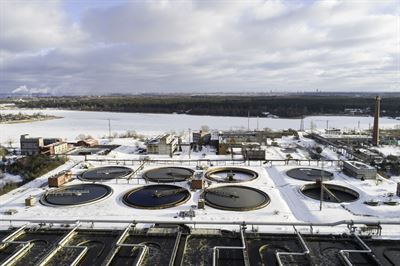
The Nordic Investment Bank has agreed a credit facility of up to EUR 50 million to co-finance SIA Rīgas ūdens’s EUR 235 million 2025–2028 water and wastewater investment programme, alongside a EUR 70 million EIB loan and proceeds from green bond issuances. Planned works include replacing >9 km of drinking-water and 14 km of wastewater pipelines per year, treatment-plant upgrades and a full digital twin rollout to reduce non‑revenue water by at least 12% by 2030; Rīgas ūdens is the first Latvian municipal issuer to access capital markets under the European Green Bond Standard. The deal strengthens the utility’s funding profile (supported by NIB’s AAA credit standing), should improve operational efficiency and tariff headroom over time, but is unlikely to be market-moving outside regional municipal/green finance sectors.
Market structure: The NIB/EIB/EuGB financing de-risks Riga’s multi-year CAPEX (EUR235m) and signals replicable municipal demand for polymer pipes, meters and digital-operations vendors across the Nordics/Baltics. Direct winners include water-tech vendors and engineering contractors; losers are legacy steel/repair services and any local suppliers with weak balance sheets. Over 2025–28 expect modest upward pricing power for specialized meters/digital twin services (+3–7% regional price premium) as municipalities front-load EU/IFI-funded upgrades.
Risk assessment: Tail risks include project delays, corruption/inflation pushing capex >10–20%, or regulatory tariff freezes that transfer cost to taxpayers and compress utility credit metrics. Near-term (days–months) impact is minimal; short-term (6–18 months) tradeable moves can arise from bond issuance pricing and tender awards; long-term (3–7 years) the structural shift to digitalised networks lowers OPEX and non-revenue water by target ≥12% by 2030, improving utility FCF. Hidden dependency: subcontractor concentration and Eurozone construction inflation are second-order exposures.
Trade implications: Direct plays are equity exposure to water-tech and concession operators and credit exposure to EU/IFI-backed green municipals. Prefer 12–36 month exposures: buy durable equipment/software providers, overweight EUR short-duration green bonds and selectively subscribe primary EuGBs where yields exceed replacement-cost break-evens. Options: use calls to leverage idiosyncratic tender wins; sell implied volatility if funding windows are narrow.
Contrarian: The market underestimates procurement execution risk and modular supply constraints—tenders often award to incumbents, creating alpha for niche local contractors not yet priced. Reaction is underdone for suppliers of digital-twin/software (as recurring revenue) and possibly overdone for large EPCs if capex stickiness disappoints. Historical parallel: post-2010 EU sewer/water cycles — winners were meter/SCADA vendors, not heavy civil names. Unintended consequence: faster digitalisation may compress multi-year O&M upside for large contractors.
AI-powered research, real-time alerts, and portfolio analytics for institutional investors.
Request DemoOverall Sentiment
mildly positive
Sentiment Score
0.32
