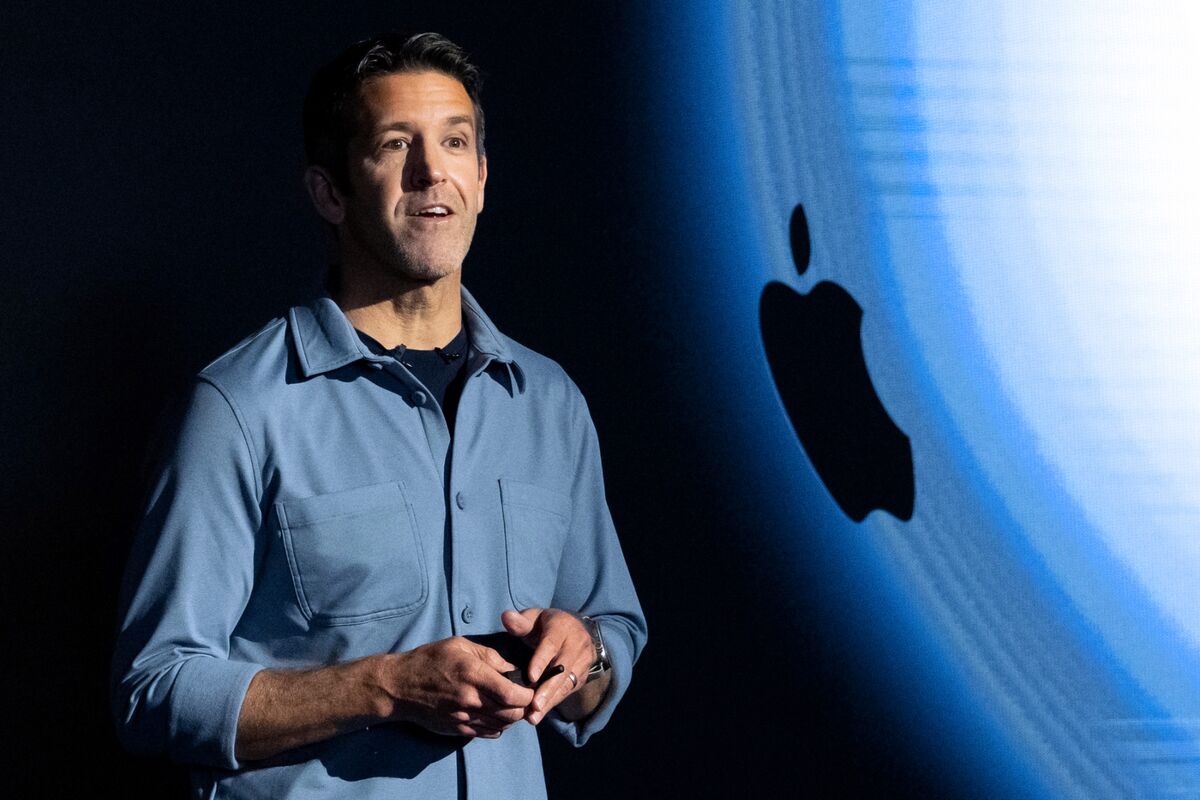
Apple’s quarterly earnings report is likely to be overshadowed by the impending CEO transition, with John Ternus set to take over from Tim Cook on Sept. 1. Investors will focus less on the results themselves and more on the outlook and any clues to Ternus’ strategic priorities. The article is primarily a leadership and expectations update rather than new financial information.
The market’s real variable is not this quarter’s print but whether the transition increases Apple’s willingness to re-rate capital allocation and product cadence. A hardware-oriented CEO tends to favor tighter execution, which could lift gross margin durability but also raises the probability of more aggressive investment in on-device AI, silicon, and supply-chain redundancy — all of which are margin-accretive only over a multi-year horizon if monetization improves. Near term, the stock may trade on any hint that the new regime is more willing to reset expectations rather than continue optimizing the old playbook. For suppliers, this is a subtle risk to concentration. If the new leadership pushes for more vertical control and component standardization, high-dependence beneficiaries can see order growth slow even if unit volumes stay healthy; that matters most for names where Apple is still a dominant customer and the multiple already discounts stable share gains. Conversely, companies exposed to Apple’s product refresh cycle but with broader end-market diversification may outperform because the governance transition reduces the perceived risk of abrupt design or sourcing shifts. The key catalyst window is the next 1-2 quarters, not the next day. If management uses the call to signal a more explicit roadmap for AI-enabled devices, services attach, or capital returns, the stock can de-risk quickly; if the call is light on strategic color, investors may interpret that as a placeholder period before the new CEO asserts control, which caps multiple expansion. The contrarian view is that the current setup may be less about uncertainty and more about optionality: any credible evidence of faster product iteration or a more disciplined capital return framework could matter more than the headline earnings variance. The biggest tail risk is that the transition amplifies execution scrutiny without changing fundamentals, leaving Apple in a “show-me” regime for several quarters. That would compress the multiple if guidance stays conservative and the market decides the new CEO is inheriting, rather than creating, the next growth chapter. In that case, relative performance likely shifts from Apple itself to higher-beta hardware and AI ecosystem names that can trade on narrative rather than proof.
AI-powered research, real-time alerts, and portfolio analytics for institutional investors.
Request DemoOverall Sentiment
neutral
Sentiment Score
0.05
Ticker Sentiment
