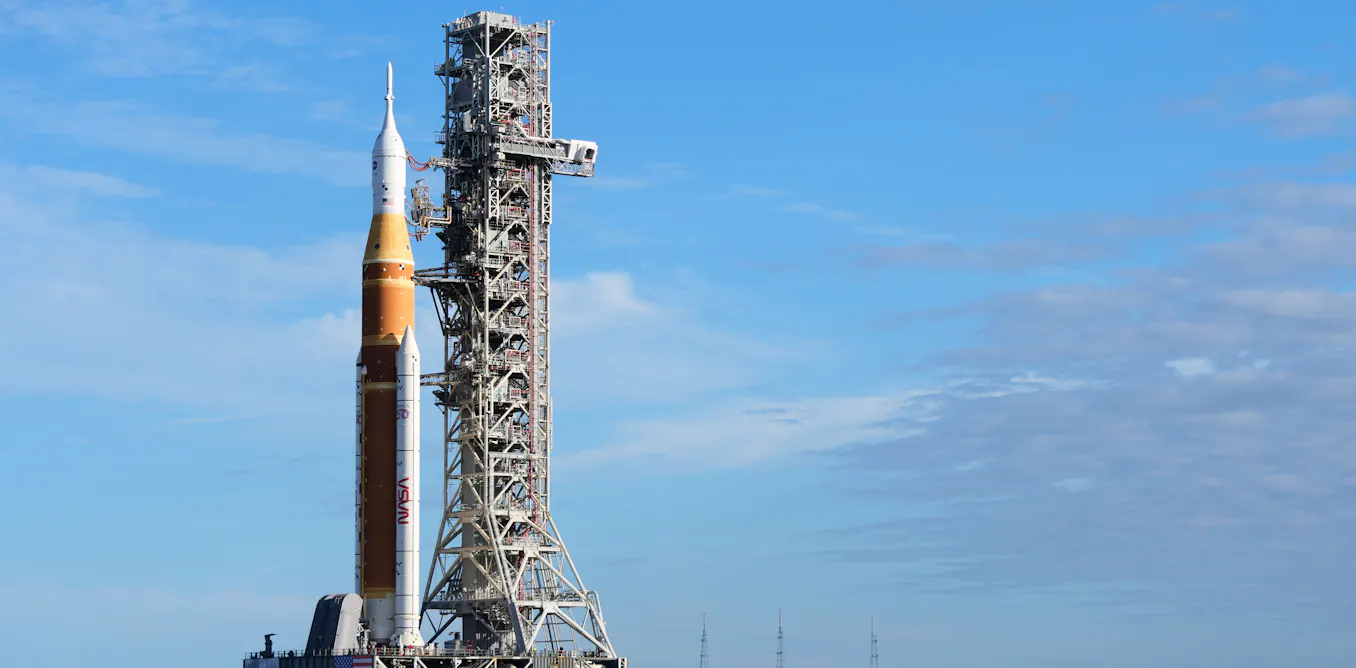
Artemis II is targeted for as soon as April 2026 to send four astronauts on a 10-day lunar flyby aboard SLS/Orion; each SLS vehicle costs "several billion dollars" and key subsystems (life support and heat shield) lack a full flight-proven record. Primary technical risks are solid rocket booster performance at launch, verification of environmental control and life-support before translunar injection, and heat-shield behavior on reentry. Strategically, the program is framed as international and commercial to shape lunar norms and limit unilateral influence (notably from China), while longer-term economics depend on uncertain resource opportunities (e.g., water, helium-3) and private-sector viability.
The Artemis program’s near-term flight test functions as a binary system-risk checkpoint for an entire cohort of contractors and the nascent cislunar services market. A clean test materially reduces technical and political friction around follow‑on sustainment contracts (EVAs, ground support, life‑support spares) and accelerates commercial partners’ willingness to commit capex; a failure forces a multi-quarter procurement re‑optimization toward cheaper, faster commercial heavy‑lift alternatives.
Second‑order supply effects concentrate on a small set of high‑margin suppliers: thermal protection & reentry materials, large solid‑motor segment manufacturers, and robotics/ISRU prototyping firms. These suppliers face lumpy revenue profiles tied to flight cadence; a persistent low SLS flight rate will shift incremental dollar allocation from heavyweight government vehicles to commercial launch and orbital services, compressing multi‑year cashflow visibility for SLS‑dependent vendors while boosting firms that scale reusable heavy lift and in‑space logistics.
Geopolitical framing amplifies program optionality: if China pulls ahead in lunar infrastructure standards, expect U.S. policy to accelerate exportable modules, interoperability standards, and allied procurement — a multi‑year revenue tailwind for primes that win early international integration work. The immediate tradeable window is the launch decision and reentry test (April 2026 horizon): outcomes there will reprice program risk premia across public and private space equities within trading days, and drive capital rotations over the following 6–24 months as agencies and contractors revise cadence assumptions.
AI-powered research, real-time alerts, and portfolio analytics for institutional investors.
Request DemoOverall Sentiment
neutral
Sentiment Score
0.05
