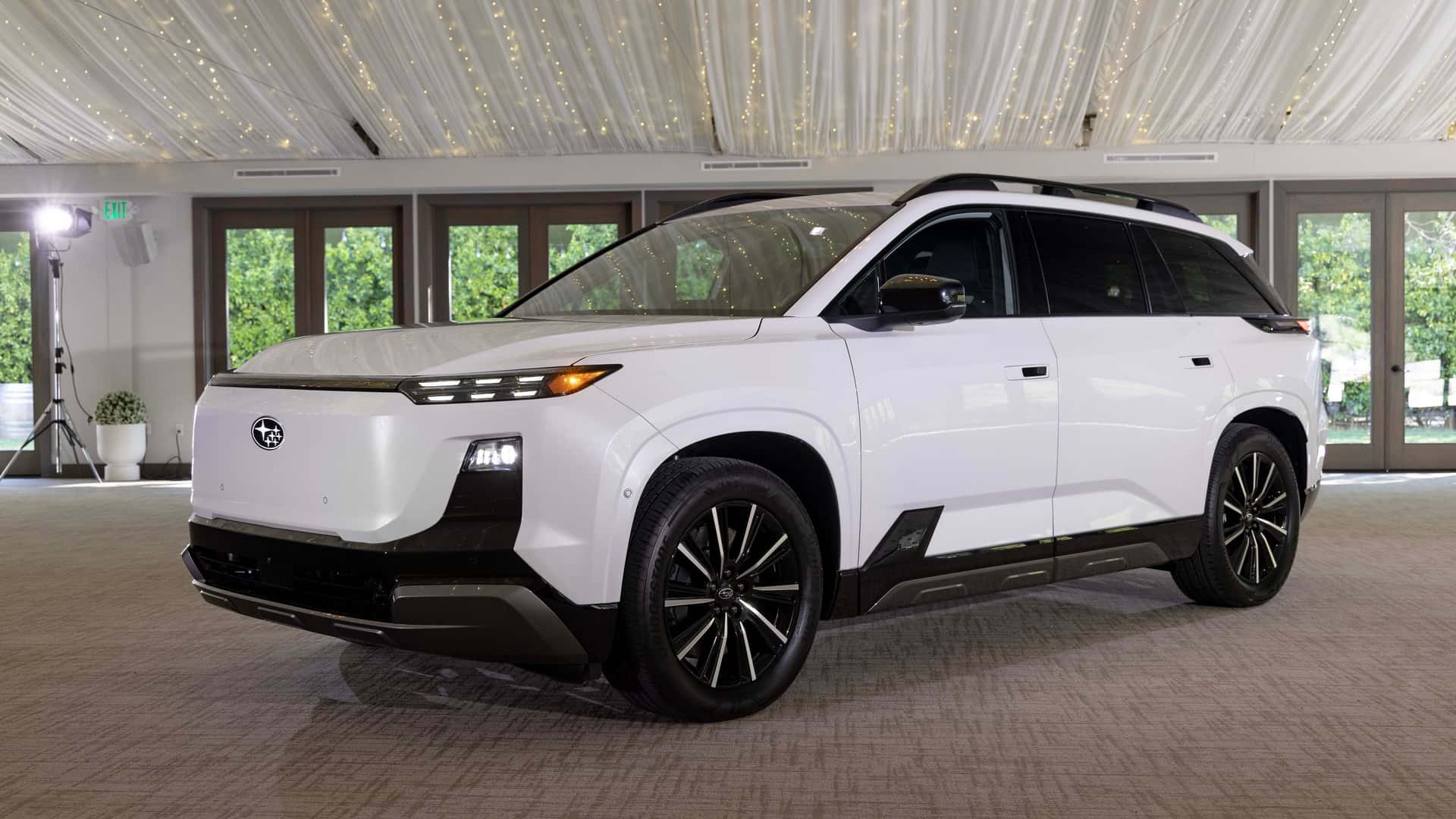
Subaru unveiled the 2027 Getaway three-row EV with a dual-motor AWD powertrain rated at 420 hp, a 95.8-kWh battery and a manufacturer-estimated range of over 300 miles; 0-60 mph is under 5 seconds and 10-80% charging at up to 150 kW takes ~30 minutes. The model offers 8.3 inches of ground clearance, 3,500 lb towing capacity, seating for six or seven, and goes on sale late 2026, positioning Subaru more competitively against Toyota, Kia and Hyundai in the EV SUV segment.
Platform sharing with Toyota is a textbook margin arbitrage: Subaru outsources engineering risk while preserving brand-specific pricing and go-to-market channels, which compresses Toyota’s per-unit engineering recovery but expands scale for battery and powertrain suppliers. That tilts second-order profits toward large cell makers and inverter suppliers who can service multiple OEMs at higher utilization, and away from smaller bespoke suppliers dependent on single-OEM programs.
NACS adoption and cross-compatibility are a latent structural catalyst — every OEM that standardizes on Tesla’s connector lowers friction for buyers and raises effective public charging capacity, which materially shortens payback for long-range models and supports residual values. This effect amplifies over 6–24 months as roaming agreements and adapter rollouts scale, and it disproportionately benefits charging-network operators and cell suppliers versus single-brand software/service revenues.
The near-term risk set is classic: demand elasticity, incentives, and raw-material swings. A 10–20% softening in retail EV demand or a 20% drop in battery cathode prices could quickly re-rate midsize premium EV ASPs and margins; conversely, regulatory incentives or fast rollouts of high-power charging could re-accelerate volume mix within 6–12 months. The consensus leans toward product-centric headlines; the non-obvious lever is capital formation in the supply chain (cells, inverters, software for roaming) and the winners will be those that capture cross-OEM scale, not necessarily the brand that ships the most cars.
AI-powered research, real-time alerts, and portfolio analytics for institutional investors.
Overall Sentiment
mildly positive
Sentiment Score
0.35
Ticker Sentiment
