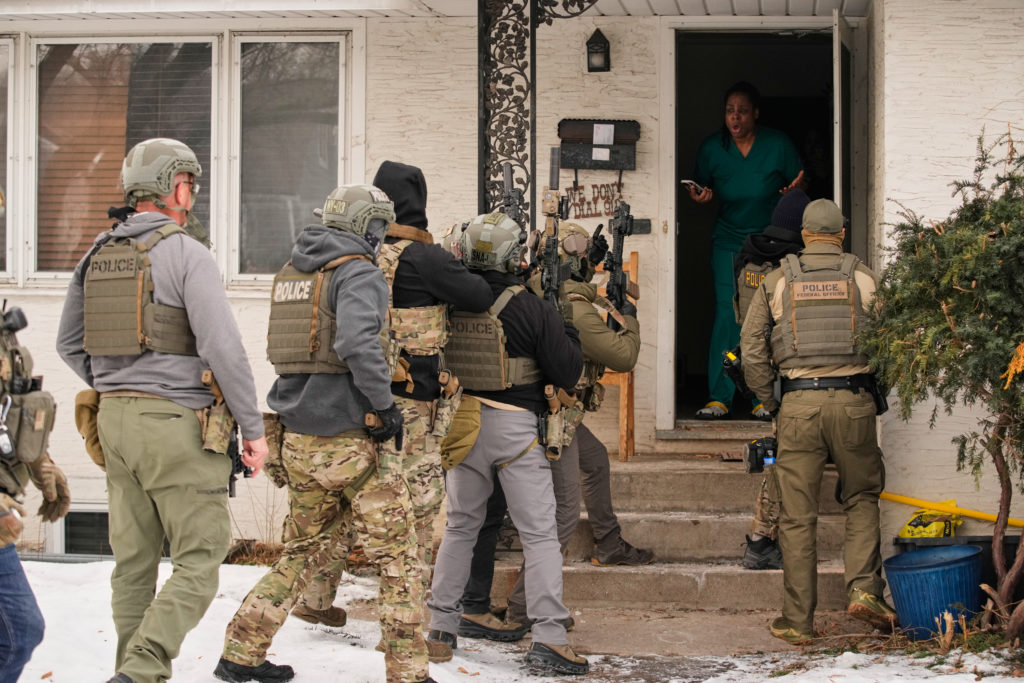
The 8th U.S. Circuit Court of Appeals has temporarily stayed a district judge's injunction that barred immigration officers in Minnesota from using tactics such as tear gas during protests, allowing the Department of Homeland Security to continue Operation Metro Surge while it appeals. The story highlights state pushback — Maine's Secretary of State paused issuance of confidential CBP license plates citing prior 'abuses of power' — and growing legal exposure after the Jan. 7 fatal shooting in Minneapolis and subpoenas to local officials; officials claim more than 10,000 arrests in Minnesota over the past year including 3,000 in recent weeks. These developments signal heightened legal and political risk for federal immigration operations and potential operational constraints, but are unlikely to move financial markets materially.
Market structure: Aggressive federal immigration sweeps create localized winners (homeland-security contractors and surveillance/vehicle-equipment suppliers) and losers (gig-economy platforms operating in targeted metros, municipal services). If driver supply in Minneapolis/Portland falls 5–10% over 30–90 days, expect on-demand delivery completion times +10–20% and platform incentive spend rising 150–300 bps, compressing EBITDA in affected markets. Cross-asset: municipal yields for affected counties could widen 10–30bps; defensives (defense contractors) may see 3–7% re-rating on incremental DHS spend assumptions over 6–12 months.
Risk assessment: Tail risks include nationwide civil unrest or broad boycotts that reduce urban order volumes 5–15% (low-probability, high-impact). Legal catalysts (8th Circuit stay vs. district judge injunction) create binary outcomes in days–weeks; a reversal restoring strict limits would reduce enforcement and soften driver-supply shocks. Hidden dependencies: local policing budgets, school closures, and insurance/liability exposures for platforms; each can amplify cost shocks if sustained beyond 90 days.
Trade implications: Direct play: tactically short DASH (DASH) via defined-risk options for 30–120 day window while taking small long exposure to L3Harris (LHX) or Raytheon (RTX) for anticipated DHS tech/vehicle demand over 6–12 months. Pair trade: long LHX (1–2% portfolio) / short DASH (1–2%) to neutralize market beta. Use 60–90 day put spreads on DASH to cap premium spend and buy 6–12 month calls on LHX/RTX for upside capture.
AI-powered research, real-time alerts, and portfolio analytics for institutional investors.
Request DemoOverall Sentiment
neutral
Sentiment Score
0.00
Ticker Sentiment
Contrarian angle: Consensus may overstate permanent driver flight — effects are likely market- and time-limited to enforcement hotspots; full-platform revenue risk is capped unless urban unrest spreads. Historical parallel: post-crisis security spend spikes (weeks→months) that benefit contractors but leave consumer platforms to recover within 3–6 months. Watch for automation acceleration (micro-fulfillment, robo-delivery) as an unintended medium-term margin pressure on gig platforms.
