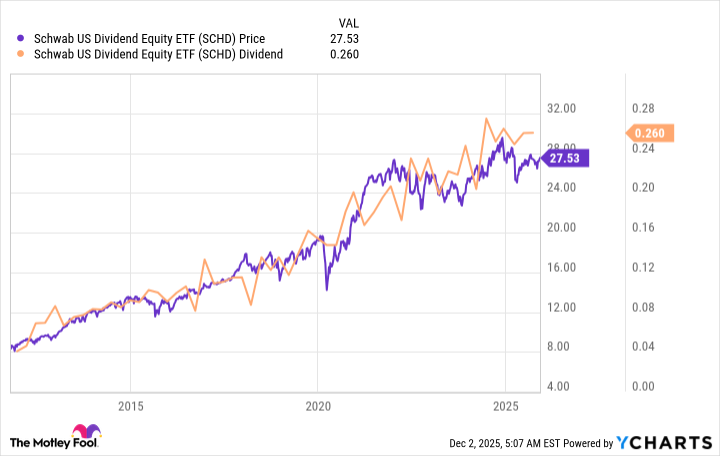
Schwab U.S. Dividend Equity ETF (SCHD) tracks the Dow Jones U.S. Dividend 100 Index, which selects 100 stocks that have raised dividends for at least 10 years and ranks candidates by a composite score (cash flow to total debt, ROE, dividend yield, five-year dividend growth). The ETF offers a roughly 3.8% yield, a low expense ratio of 0.06%, is market-cap weighted and rebalanced annually, and is currently underweight technology (8%) while overweight energy (19%), consumer staples (18%) and healthcare (16%); a $1,000 purchase now would buy about 36 shares. The fund is presented as a diversified, cost-efficient option for dividend-focused allocations and as a complement to tech-heavy S&P 500 exposures (tech ~36% in the S&P 500).
Market structure: Dividend-focused large caps (energy: XOM/CVX; staples: KO/PG; healthcare: JNJ/MRK) directly benefit from flows into SCHD’s Dow Jones U.S. Dividend 100 exposure, while high-growth tech leaders (AAPL/MSFT/NVDA) are relatively disadvantaged given SCHD’s ~8% tech weight vs S&P’s ~36%. Market-cap weighting plus an annual rebalance means gradual, predictable demand into financially stable, cash-flow-rich names rather than rapid rotation; expect modest upward pressure on dividend-stock multiples if flows accelerate.
Risk assessment: Key tail risks are a rapid rate shock (10‑yr >4.25% in weeks), sector-specific dividend cuts (energy/financial shocks) or a sharp commodity collapse; any of these would compress SCHD NAV and widen spreads. Time horizons matter: immediate (days) — tradeable if ETF sees outsized inflows/outflows; short-term (weeks/months) — sector rotation vs tech; long-term (quarters/years) — dividend growth and yield compete with bond yields. Hidden dependencies include sensitivity to 10‑yr moves and energy-price volatility; catalysts include Fed commentary, CPI prints, and oil supply disruptions.
Trade implications: Implement income-plus-rotation trades: overweight SCHD vs QQQ to capture yield-rotation (see tactics below). Use covered-call overlays on SCHD to monetize ~3.8% yield into a targeted 7–10% annual income stream, and buy selective energy exposures (XOM/CVX) as commodity hedges. Entry should be staged in 2 tranches over 2–6 weeks; trim if 10‑yr yield breaches 4.25% or CPI surprises to the upside.
Contrarian angle: The consensus that tech must dominate underprices the re-rating potential if monetary policy loosens — dividend equities historically outperform in multi-quarter easing cycles (post‑2019, post‑2020 recoveries). The crowding risk is real: heavy inflows could compress yields and raise valuation sensitivity to dividend cuts. A disciplined trigger-based approach (rate/CPI/oil thresholds) avoids being late into a crowded yield trade.
AI-powered research, real-time alerts, and portfolio analytics for institutional investors.
Request DemoOverall Sentiment
moderately positive
Sentiment Score
0.35
