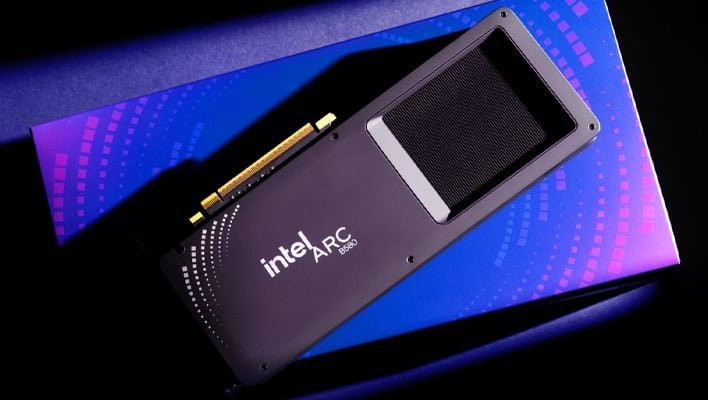
An Intel VTune Profiler patch note referencing 'BMG-G31' (Big Battlemage) support provides the strongest public signal yet that a larger Battlemage GPU may be launched; rumored specs include a full 256-bit memory bus and PCIe 5.0 x16. The piece notes the card’s competitiveness will hinge on pricing and driver maturity versus AMD’s Radeon RX 9060 XT (around $349) and potential DRAM supply/pricing disadvantages, and suggests Intel could quietly announce the SKU at CES alongside new CPUs.
Market structure: A shipping BMG-G31 would primarily benefit INTC (channel share in $200–$400 gaming GPUs) and GDDR6 suppliers if Intel prices competitively; it erodes AMD/NVDA mid-range pricing power and could force street-level price cuts of 10–25% on mid-tier SKUs over 6–12 months. Supply signals: a full 256-bit bus implies >8GB GDDR6 per card raising incremental GDDR6 demand; a 5–15% spot rise in GDDR6 over 3–9 months would be consistent with small GPU ramp. Cross-asset: higher semiconductor idiosyncratic vol likely lifts options IV in INTC/AMD/NVDA by 20–40% around CES; negligible sovereign bond impact but positive commodity signals for Micron (MU) and SK Hynix.
Risk assessment: Tail risks include catastrophic driver/performance failures (90-day review window) that could cut GPU attach sales 30–50% and provoke warranty costs, or a DRAM price spike that makes ASPs uncompetitive. Immediate (days): rumor-driven IV spikes; short-term (weeks–months): CES reveal and first reviews; long-term (12–24 months): market-share reallocation if drivers/partners scale. Hidden dependencies: partner board designs, BIOS/driver maturity, and pre-purchased GDDR6 inventory levels that determine pricing flexibility. Key catalysts: CES announcement (target: Jan), independent benchmarks (first 2 weeks post-launch), and GDDR6 spot contract prints.
Trade implications: Tactical long INTC exposure is asymmetric pre-CES if priced below peers — prefer defined-risk option spreads (3-month call spread sized 0.5–2% portfolio) to capture announcement upside; contrapuntal short on AMD GPU sensitivity (small size, 1% or less) if INTC’s product benchmarks beat RX 9060 XT by >10% at similar price. Buy 1–2% exposure to MU on confirmed GDDR6 spot increase >10% QoQ or if partners confirm 256-bit designs; hedge semis exposure with 1% SMH puts if IV rises >25% into CES. Monitor IV, review scores and GDDR6 prints weekly.
Contrarian angles: The market understates driver/architecture gains—if Intel’s Xe2 drivers show a 10–20% uplift in real-world titles vs B580, INTC equity could rerate 20–40% over 6–12 months. The consensus overweights DRAM risk; unless GDDR6 contracts jump >20% the competitiveness advantage of a 256-bit bus remains material. Historical analog: early discrete GPU launches (Intel’s own past missteps) show Beijing-level partner execution and software are the margin between hype and realized share—this is the true binary. Unintended consequence: aggressive pricing by Intel could compress AMD’s mid-range GPU margins by 200–400bps over 4 quarters, creating a profitable short window.
AI-powered research, real-time alerts, and portfolio analytics for institutional investors.
Request DemoOverall Sentiment
mixed
Sentiment Score
0.05
Ticker Sentiment
