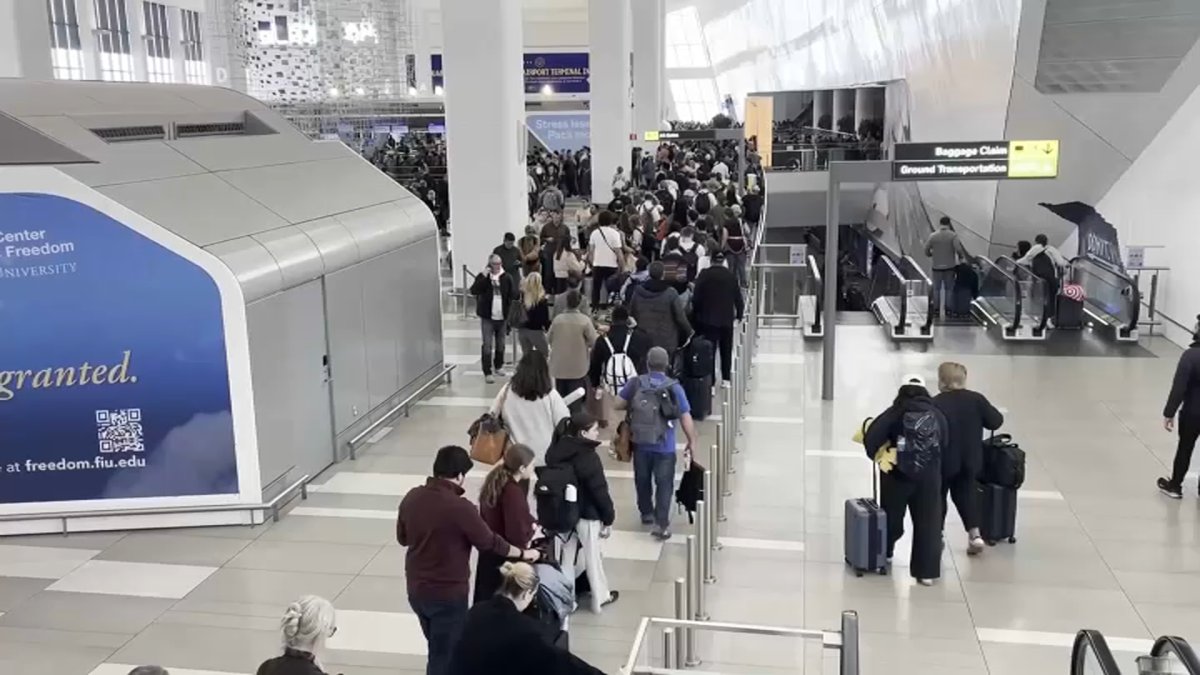
TSA callouts spiked to 11.5% nationwide on Saturday with localized rates ~17% at LaGuardia and ~33% at JFK, and more than 400 resignations reported as officers remain unpaid amid a DHS funding impasse. President Trump announced ICE agents will be sent to airports starting Monday to provide supplemental security support (not screening) while Congress stalls on DHS funding; a Senate Democratic bid to fund TSA was voted down by Republicans. Operational risk to airports and airlines is elevated (longer passenger lines, delays, reputational/possible financial impacts) but the disruption is sector-specific pending political resolution.
Operationally, this is a classic capacity shock to a just-in-time network: screening throughput falls faster than airlines can re-time schedules, which raises cancellation risk non-linearly as delays compound across hub-and-spoke systems. Carriers running high-frequency, tightly timed short-haul routes and those with lower unit revenue per passenger have the weakest buffer — a 48–72 hour staffing crunch can wipe out a week of planned utilization and force short-term network culls that hit unit revenues.
On the policy side, a protracted funding impasse raises the probability of stopgap bilateral spending and surge-contract awards to government services and security vendors; those dollars are sticky (multi-week to multi-quarter) and favor incumbents with DHS experience and rapid deployment capacity. Conversely, airports and concession revenue face margin compression from lower throughput and passenger dwell-time declines until either staffing normalizes or airlines reprice capacity.
Second-order logistics effects are underappreciated: time-sensitive air cargo (pharma, high-value electronics, perishables) will shift volumes to truck and express carriers, boosting short-term pricing power for ground freight players and pressuring last-mile networks. A swift congressional fix within a few days would materially re-rate travel names; a multi-week standoff shifts the market to a higher-volatility regime where contract winners (screening tech/service providers) and schedule-robust carriers outperform.
AI-powered research, real-time alerts, and portfolio analytics for institutional investors.
Overall Sentiment
mildly negative
Sentiment Score
-0.30
