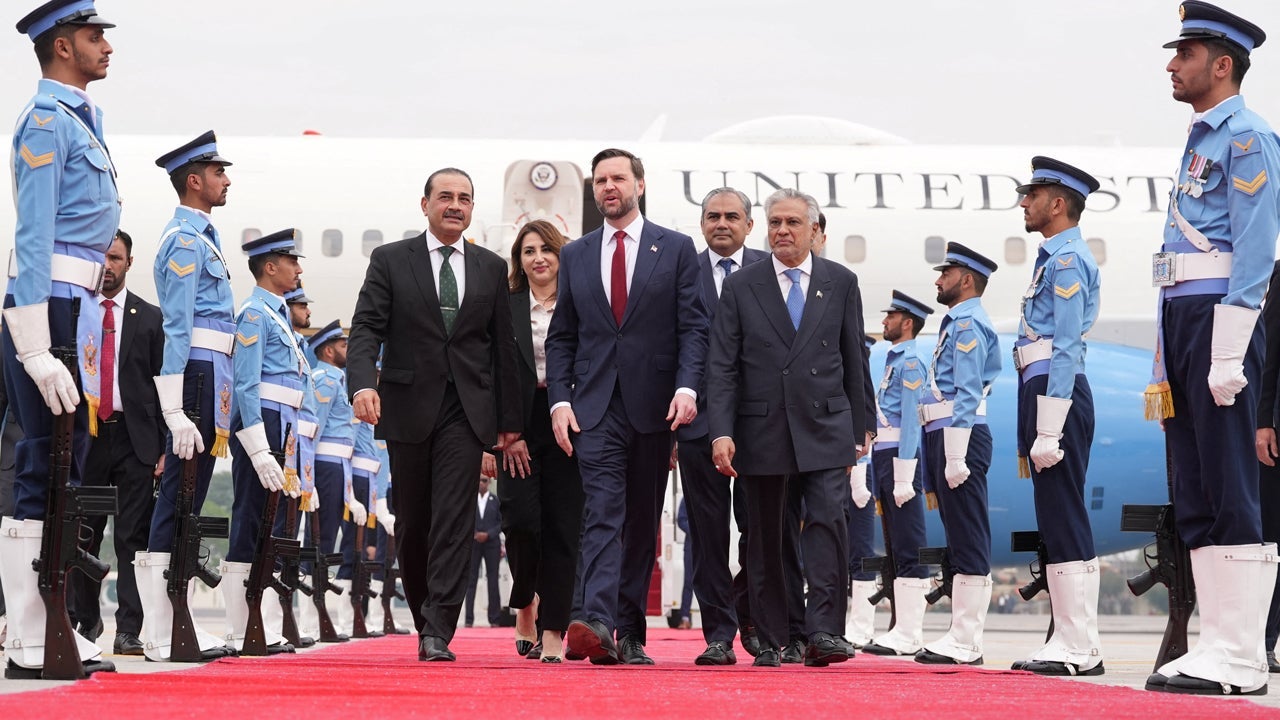
U.S.-Iran ceasefire talks in Islamabad remained unresolved after more than 21 hours, with Vice President JD Vance saying Iran "chose not to accept our terms" and no agreement reached. The standoff has already disrupted shipping through the Strait of Hormuz, driven a backlog of roughly 3,200 vessels, and prompted U.S. mine-clearing operations and heightened military readiness in the region. The article also highlights ongoing strikes in Lebanon and broad geopolitical escalation risks tied to energy flows and regional security.
The market implication is less about the diplomacy headline and more about the operational asymmetry: even if there is a ceasefire, shipping cannot instantly reprice risk back to normal. When a sea lane has just been militarized and mined, the first beneficiaries are not crude producers but risk-premium suppliers: marine insurance, naval contractors, underwater systems, and firms with expeditionary logistics exposure. The lag between “talks progress” and “cargo actually moves” can stay weeks to months, which keeps freight, bunker, and fertilizer input costs elevated even in a benign headline scenario.
Energy pricing likely sees a fast mean-reversion in the front end but a slower unwind in physical bottlenecks. If the Strait reopens in stages, tanker availability and port scheduling, not spot crude supply, become the binding constraint; that tends to preserve volatility in refined products and gas more than headline Brent. The second-order loser is import-dependent industrial/ag names with thin inventory buffers, because fertilizer, feedstock, and shipping costs can remain sticky after the geopolitics headline fades.
The bigger contrarian point is that a half-settled conflict can be more inflationary than an outright shock: markets stop discounting catastrophe but still pay up for uncertainty. That means defense and logistics names can outperform even as crude retraces, while rate-sensitive cyclicals and EM importers remain vulnerable to persistent cost pass-through. Any deal that does not fully normalize maritime traffic is functionally a volatility regime, not a peace regime.
The ICE angle is modestly negative, but the market may be underpricing duration risk. ICE’s core exposure is to immigration enforcement and policy normalization; a broader national-security backdrop can preserve enforcement budgets and keep the stock insulated from headline drift. The bigger issue is political: if the administration pivots to a more conciliatory foreign-policy posture, domestic enforcement rhetoric could lose intensity, which is a medium-horizon multiple risk rather than an earnings shock.
AI-powered research, real-time alerts, and portfolio analytics for institutional investors.
Request DemoOverall Sentiment
mildly negative
Sentiment Score
-0.35
Ticker Sentiment
