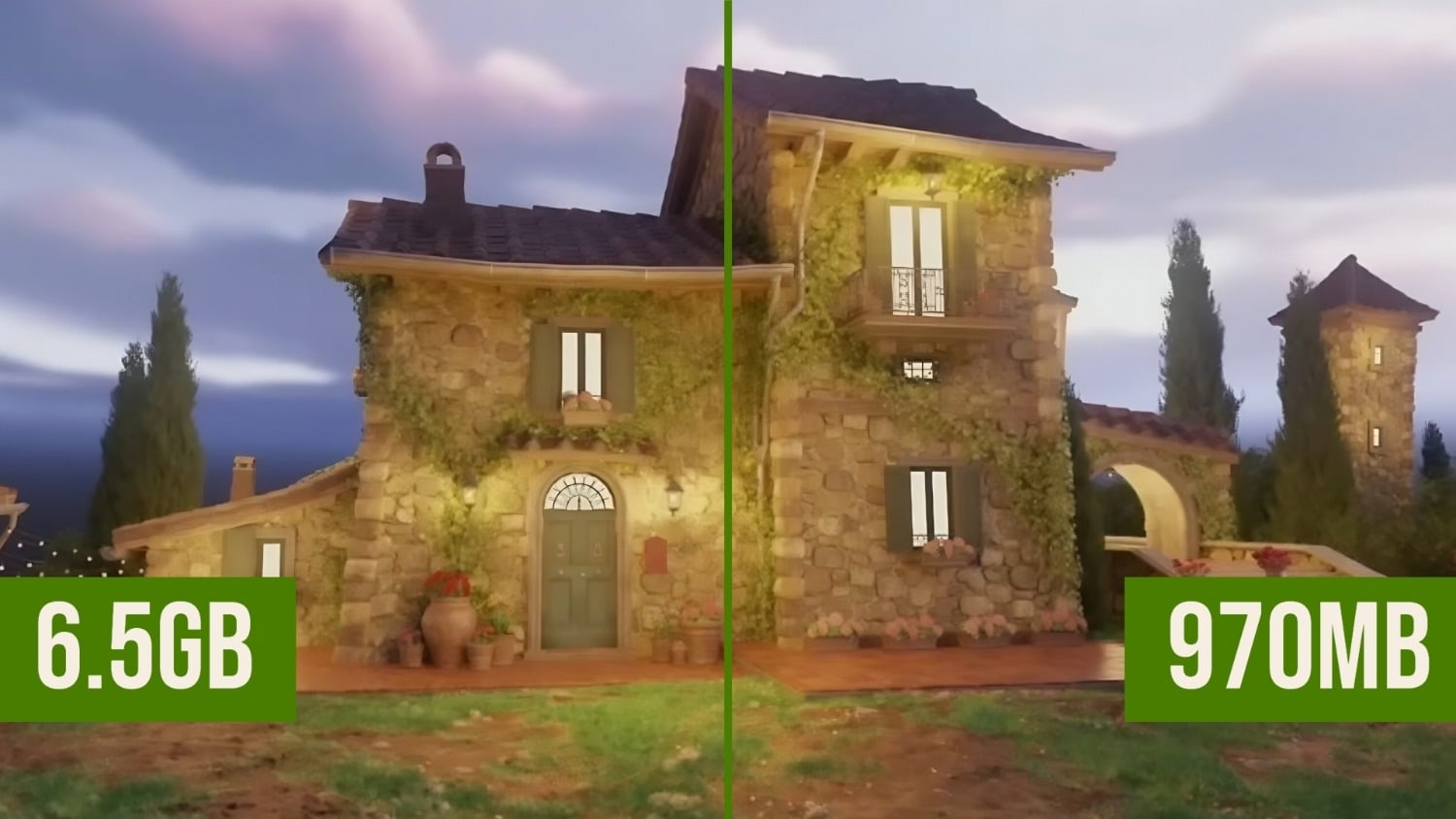
NTC delivered an ~85% VRAM reduction in NVIDIA's demo, cutting a Tuscan Villa scene from 6.5GB to 970MB while maintaining or improving visual fidelity. Neural Texture Compression deterministically encodes texture latents and reconstructs them on GPU Tensor Cores, reducing VRAM needs and game install/patch sizes and benefitting users with 6–12GB GPUs. The RTXNTC SDK is available on GitHub now, accelerating potential developer adoption and making this a materially positive sector-level development for PC gaming and GPU demand.
NTC shifts the architecture of value capture from raw texture storage to on-GPU inference throughput and software hooks. That favors vendors with abundant Tensor/AI pipeline capacity and tight SDK lock-in (NVIDIA), while creating ambiguity for suppliers historically paid to supply larger VRAM footprints — the market is about to reprice compute-per-byte, not bytes-per-se. Developers face a two-sided opt-in decision: adopt NTC to lower install sizes and broaden playable settings on mid-tier GPUs, or stick with legacy pipelines to avoid retraining, certification, and potential visual edge-cases; that bifurcation will play out over quarters, not overnight.
Second-order supply-chain effects are non-obvious: lower persistent demand for high-capacity GDDR in gaming GPUs could compress ASPs for GPU memory modules, while increasing demand for silicon with denser AI math units and better power-efficiency for continuous inference. Console and system-on-chip vendors (custom AMD in consoles, integrated Intel/AMD laptop GPUs) become strategic swing factors — if consoles standardize NTC, it accelerates scale; if they don’t, PC-first adoption will limit total addressable compute uplift. Expect meaningful mix shifts in BOMs across a 6–24 month window.
The main tail risks are developer inertia, perceivable artifacting under edge lighting/materials, and a rapid competitive replication by AMD/Intel or open-source toolchains that erode Nvidia’s software moat. Near-term catalysts: major engine integrations (Unity/Unreal) and a “must-have” AAA title shipping with NTC will move developer sentiment; negative image-quality headlines or a cross-platform reference implementation could reverse momentum within months. Volatility around those events creates defined entry points for asymmetric option structures.
AI-powered research, real-time alerts, and portfolio analytics for institutional investors.
Request DemoOverall Sentiment
strongly positive
Sentiment Score
0.70
Ticker Sentiment
