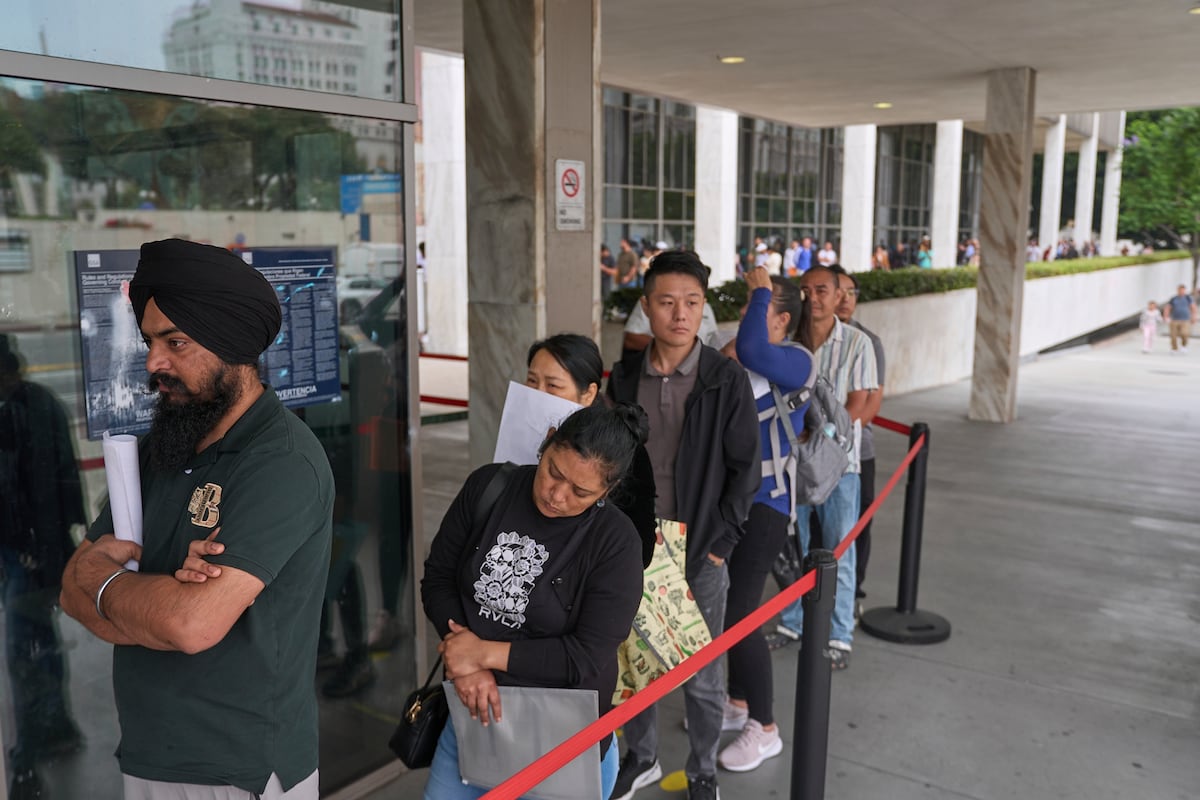
The Trump administration has paused U.S. citizenship, green‑card and asylum adjudications for nationals of 19 “countries of concern” (including Cuba and Venezuela), ordered a large‑scale review of every green card from those countries, and shortened work permits to 18 months, with USCIS saying suspensions will remain until vetting can be ‘‘guaranteed’’; the freeze affects more than 1.5 million pending asylum claims and has already led to canceled naturalization interviews and bank warnings about account closures. The measures—an expansion of the June travel ban and part of a broader push to pressure migrants into self‑deportation—have created immediate legal and social uncertainty for permanent residents and parole beneficiaries, prompted warnings of more detentions and litigation, and risk disrupting labor supply and consumer demand in sectors dependent on immigrant workers. For investors, the policy raises operational and regulatory risk for industries exposed to immigrant labor (hospitality, agriculture, construction, care services), increases the likelihood of legal challenges and reputational risk, and adds an element of macroeconomic uncertainty as affected populations curtail spending and mobility.
The administration has implemented a broad suspension and intensified vetting of immigration processes for nationals of 19 "countries of concern," pausing applications for permanent residency, naturalization and asylum and ordering a "rigorous, large-scale review" of every green card from those countries, according to USCIS director Joseph B. Edlow; the freeze affects more than 1.5 million pending asylum claims, naturalization interviews have been canceled and work permits have been shortened to 18 months from as long as five years. Reported downstream consequences include bank notices asking migrants to update status to avoid account freezes and cancelled citizenship oaths, signalling administrative friction that immediately constrains financial access and mobility for affected populations.
Operationally, the policy raises near-term labour-supply risks for sectors concentrated in immigrant workforces—hospitality, agriculture, construction and care services—and likely depresses consumer demand in immigrant-heavy metros as households lose work authorization, driving licenses and banking access. The administration’s stated goal of encouraging self-deportation combined with reduced permit durations will likely increase turnover, force informal employment growth and amplify compliance costs for employers.
Legal and reputational risk is elevated: attorneys cited in the article expect an increase in stalled cases and litigation, and firms face ongoing uncertainty because there is no resumption date; the market sentiment signal is strongly negative and market impact score is modest (0.25), implying limited immediate market shock but meaningful medium-term downside risk to exposed names. Investors should expect headline-driven volatility tied to court rulings, USCIS guidance and enforcement actions over the coming quarters.
AI-powered research, real-time alerts, and portfolio analytics for institutional investors.
Request DemoOverall Sentiment
strongly negative
Sentiment Score
-0.70
