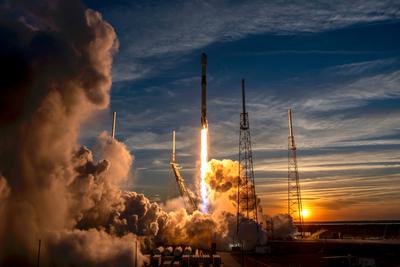
Rapid commercial satellite deployment—Starlink has sought FCC permission to expand toward 42,000 units and industry filings suggest >100,000 active satellites could orbit by 2040—has triggered scientific concern that routine launches and reentries are injecting metals and particulates (PNAS and GRL studies cite aluminum oxide nanoparticles, lead, lithium, etc.; a single 550‑lb satellite can produce ~70 lb of aluminum oxide on ablation) into the mesosphere/stratosphere with potential ozone and climate impacts. Model and field-study gaps, fuel tradeoffs (RP‑1 black carbon vs. methane’s lower soot but larger vehicle mass, solid boosters’ chlorine), and proposed responses (design-to-survive satellites, reusable/recyclable modular hardware, international quotas) imply rising regulatory, technological and ESG costs that pose a medium-term risk to space-sector economics and investors.
Market structure: Rapid satellite scale-up creates winners in on-orbit services, SSA (space situational awareness), and regulation/compliance providers while increasing downside for disposable small-sat manufacturers and raw-material suppliers if “design to survive” or material bans arise. Expect pricing power for firms that offer debris removal, rendezvous/tug services, and certified low-emission launch profiles; cyclical launch demand may compress margins for mass-built disposable-satellite OEMs. Growth projections (42k Starlink; >100k by 2040) imply sustained capex but rising regulatory friction that will reallocate value up the stack to service and systems integrators over 12–36 months.
Risk assessment: Tail risks include swift regulatory caps (launch quotas, material bans) within 12–24 months, major collision cascade (Kessler) reducing launch demand for years, or scientific findings (e.g., aluminum-oxide aerosols causing meaningful ozone depletion) triggering expensive retrofits. Near-term risks (days–months) are reputational and permitting delays; medium-term (6–24 months) are policy/contract shifts; long-term (2–5 years) are structural industry redesigns and capital reallocation. Hidden dependencies: insurance, government space budgets, and LNG vs RP-1 fuel economics; catalyst watchables: ESA/NASA field campaigns (24 months) and FCC/UN proposals (next 6–12 months).
Trade implications: Prefer long exposure to space-services and defense primes that can capture contracting (e.g., MAXR, NOC/LMT) and underweight pure-play disposable-satellite OEMs and commodity aluminum producers if material restrictions emerge. Use modest put protection on AMZN (Kuiper capex/regulatory risk) and favor options to express asymmetric views around 6–18 month catalysts (ESA reports, FCC rulings). Rebalance to favor stocks with recurring-service revenue and government contracting leverage over capex-heavy launch OEMs.
Contrarian angles: Consensus underestimates cost of retrofitting the industry and speed of regulation; market may be slow to reprice service integrators and debris-removal specialists. Reaction to initial negative studies will be gradual — early-stage panic is unlikely — creating a 6–24 month alpha window to buy SSA/servicing names before broad policy-driven reallocation. Historical parallel: early environmental regulation in aviation/auto re-priced suppliers and aftermarket/service businesses ahead of OEMs; expect similar pattern in space.
AI-powered research, real-time alerts, and portfolio analytics for institutional investors.
Request DemoOverall Sentiment
moderately negative
Sentiment Score
-0.40
Ticker Sentiment
