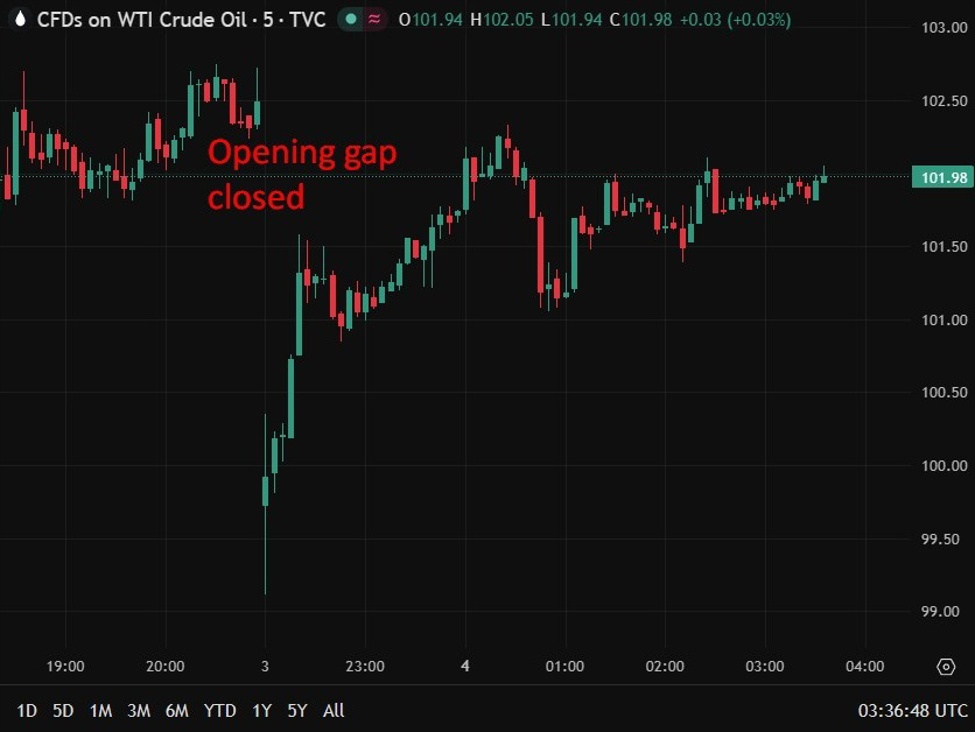
Geopolitical risk in the Strait of Hormuz escalated sharply as Trump announced Project Freedom, with CENTCOM saying military support begins May 4 and deploying destroyers, 100-plus aircraft and 15,000 service members. A tanker was struck by unknown projectiles off Fujairah, while Iran rejected the plan as a ceasefire violation, keeping oil and shipping risks elevated; ANZ also sees Brent above $90 in 2026 with $100-plus risk into 2027. On the macro side, Kashkari warned the Iran war could force Fed rate hikes, and the RBA is widely expected to hike 25 bps tomorrow amid split board dynamics and rising Australian inflation pressure.
The market is still underpricing the difference between a headline de-escalation and a real de-risking of Hormuz. Project Freedom reduces the probability of an immediate supply shock, but it also formalizes a state-backed corridor that makes any subsequent incident more market-relevant because attribution gets cleaner and retaliation thresholds drop. That is usually bullish for prompt oil volatility even if spot crude sells off on the first announcement, because shipping insurers, charterers and refiners will keep paying up for optionality until there is a credible multi-week record of safe transits.
The second-order loser is not just crude importers; it is the entire Asia ex-Japan industrial complex that depends on stable feedstock and freight. If transit risk persists, the first P&L damage shows up in working capital, insurance and inventory buffers before it appears in end-demand, which argues for pressure on airlines, chemicals and discretionary retail with high fuel sensitivity. Conversely, integrated energy and quality tankers can benefit even if Brent is range-bound, because day rates and war-risk premia can remain elevated while physical volumes are merely rerouted.
The RBA setup is unusually asymmetric: the conflict adds upside to inflation while domestic activity is softening, which increases the odds of a hawkish surprise but also raises the chance of a split board and a weak forward-guidance response. That favors relative value over outright duration — short AUD duration or long front-end rates versus AUD equity beta is cleaner than a naked AUD short. The bigger macro risk is that if Hormuz stays tense for another 2-6 weeks, central banks will be forced to choose between fighting imported inflation and avoiding growth damage, which typically steepens volatility across FX and the front end.
The consensus seems to be treating the U.S. naval presence as a stabilizer; the more important point is that it compresses the timeline for a miscalculation. That means the tail is not just higher oil, but a larger gap between overnight headlines and closed-market repricing in Asia, which tends to punish crowded carry trades and low-volatility positioning first. Near-term, the trade is not to bet on a straight-line spike in Brent, but to own convexity against another tanker incident or failed transit, because those are the catalysts that can reset price bands by $8-15/bbl in a single session.
AI-powered research, real-time alerts, and portfolio analytics for institutional investors.
Request DemoOverall Sentiment
moderately negative
Sentiment Score
-0.20
Ticker Sentiment
