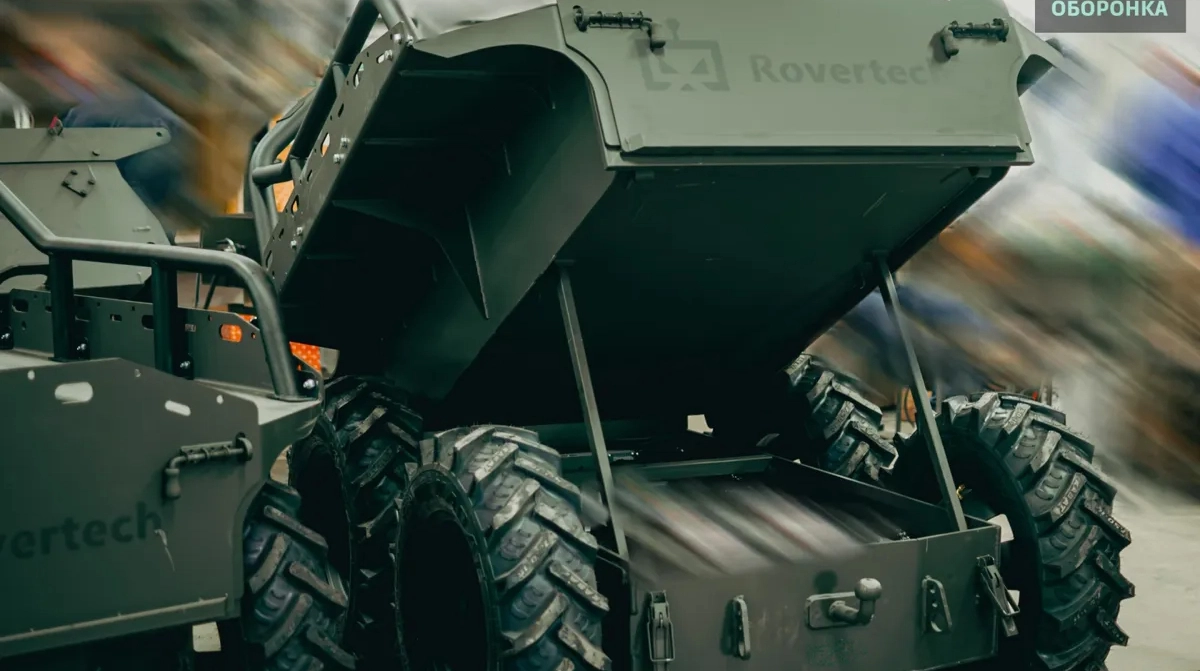
Rovertech has developed multiple specialized Zmii unmanned ground robot variants, including a manipulator/excavator version, a 0.6 cubic metre tipper-lorry model carrying up to 1.3 tonnes, and a firefighting configuration already deployed in Ukraine. The company says all variants have light fragmentation protection and can be produced within days thanks to a standardized chassis. The article is primarily a military technology update with limited direct market impact.
The key market signal is not the individual robot variants, but the shortening of the product-to-field loop: a chassis that can be reconfigured in days turns a niche defense manufacturer into a rapid-response platform supplier. That favors companies and ecosystems that can standardize powertrains, autonomy stacks, teleoperation links, and modular payloads, while disadvantaging legacy defense primes optimized for long procurement cycles and bespoke platforms. The second-order implication is that battlefield demand is moving from “more robots” to “more mission-specific robots,” which should raise attach rates for sensors, comms, batteries, and ruggedized components rather than just the base vehicle itself. Operationally, the most durable demand driver is infrastructure repair under fire. If unmanned logistics systems become the default for crater filling, debris movement, and fire response, the TAM expands beyond combat into civil resilience and rear-area support, creating recurring replacement and maintenance demand. That supports a longer-duration theme in autonomy, electronic protection, and off-road electrification, while also creating a hidden bottleneck in field service and spare parts rather than raw unit production. The main risk is that these systems are still highly dependent on contested RF environments and cheap-drone attrition economics; if adversaries improve jamming, optical targeting, or loitering munition persistence, the cost curve could invert quickly. Near term, the catalyst is continued validation from frontline use cases over the next 1-3 months; over 6-12 months, the trade becomes whether procurement scales from experimental deployments into standardized fleet orders. The contrarian takeaway is that the biggest beneficiary may not be the robot OEM itself, but suppliers of batteries, ruggedized connectors, embedded compute, and counter-UAS protection that scale across every variant. For public markets, the signal is bullish for diversified defense-electronics and autonomy enablers, but not for bidding up pure-play robotics names indiscriminately; battlefield adoption tends to be lumpy and execution risk is high. The market may be underpricing how quickly low-cost modular systems can displace manned support roles in permissive but dangerous logistics tasks, which is a gradual margin tailwind for integrators and subsystem vendors rather than a headline-grabbing platform thesis.
AI-powered research, real-time alerts, and portfolio analytics for institutional investors.
Request DemoOverall Sentiment
neutral
Sentiment Score
0.15
