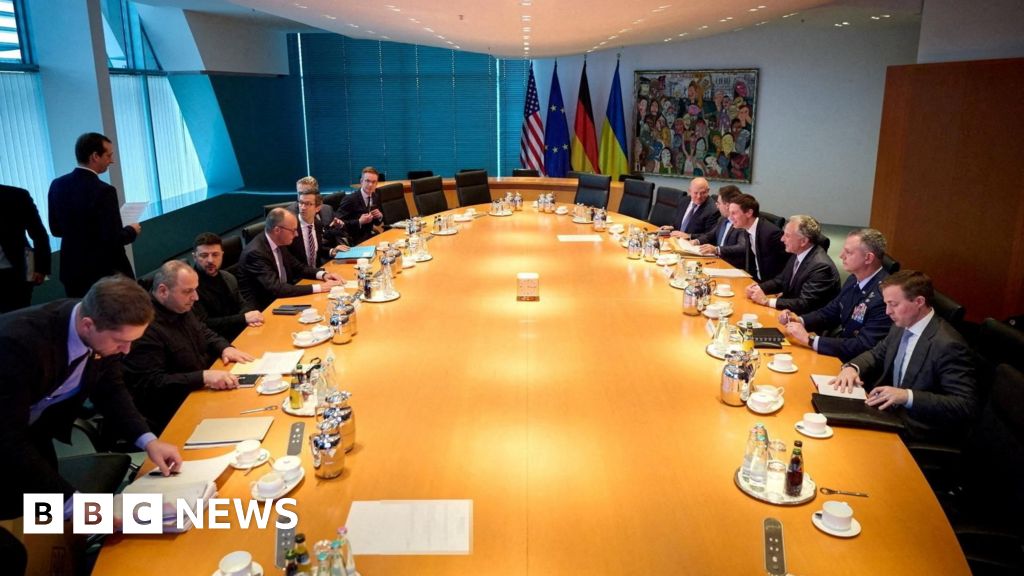
Senior US, Ukrainian and European officials held multi-day talks in Berlin—Ukrainian President Zelensky, negotiator Rustem Umerov and US envoys including Steve Witkoff and Jared Kushner met with German Chancellor Friedrich Merz and NATO Supreme Allied Commander Alexus Grynkewich—where the US said significant progress was made as Kyiv signalled willingness to abandon its bid for NATO membership in exchange for robust, Article 5‑style security guarantees and presented a 20‑point peace plan countering an initial US proposal seen as favoring Russia. Core sticking points remain Russia’s red lines on NATO expansion and control over parts of the Donbas, with Zelensky open to freezing front lines only if Russia reciprocates withdrawals; US delegates are reportedly relaying Russian signals but any accord must still be accepted by Moscow. The negotiations come amid acute wartime pressures—recent strikes caused widespread winter power outages—and are unfolding alongside fraught EU deliberations over unlocking €90bn of frozen Russian assets to fund Ukraine’s reconstruction, a move that remains legally and politically contested.
Senior US, Ukrainian and European officials met in Berlin for multi-day ceasefire talks that the US described as producing "a lot of progress" after a five-hour session on Sunday that resumed Monday; attendees included President Zelensky, negotiator Rustem Umerov, US envoy Steve Witkoff, Jared Kushner, German Chancellor Friedrich Merz and NATO SACEUR Alexus Grynkewich. Kyiv signalled it is willing to forgo NATO membership in exchange for strong, Article 5-style security guarantees and has tabled a 20-point counterproposal to an earlier US plan seen as favoring Russia.
Key negotiating impasses remain: Moscow treats Ukrainian NATO aspirations as a red line and demands territorial concessions in the Donbas, while Zelensky says he will only agree to freeze lines if Russian forces reciprocate withdrawals; the US delegation is reportedly relaying Russian signals but any agreement still requires Moscow's acceptance. These dynamics keep the probability of a negotiated end to hostilities conditional and politically fragile.
The talks occur amid acute wartime pressures—over the weekend more than one million Ukrainian households lost power after strikes—and parallel fraught EU deliberations over mobilising €90bn (£78.6bn) of frozen Russian assets, a proposal Belgium resists and other EU states call legally contentious. Market sentiment is mixed and the article signals a material but uncertain market impact driven by geopolitical, sanctions and energy-infrastructure risks.
AI-powered research, real-time alerts, and portfolio analytics for institutional investors.
Request DemoOverall Sentiment
mixed
Sentiment Score
0.05
