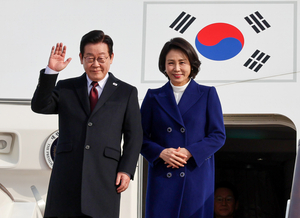
South Korean President Lee Jae Myung's four-day state visit to China is aimed at stabilizing Seoul–Beijing ties amid US–China strategic competition, with security flashpoints — North Korea's missile activity, Taiwan, Korea–US alliance modernization, and Seoul's pursuit of nuclear-powered submarines — dominating the agenda and limiting scope for concrete outcomes. Practical deliverables are expected in cultural exchanges and narrowly defined economic niches (tourism, cosmetics/duty-free, and selective industrial cooperation in biotech and AI) alongside Phase II discussions of the Korea–China FTA; meaningful progress will depend on Beijing offering specific institutional mechanisms while US export-regulatory constraints and geopolitical risk will cap deeper collaboration. Investors should monitor implications for semiconductors, defense-related supply chains, and consumer sectors tied to tourism and entertainment, but the trip is unlikely to produce immediate market-moving breakthroughs absent clear, concrete commitments from China.
Market structure: The summit biases winners toward Korean consumer/tourism (duty‑free, cosmetics), select biotech/AI suppliers, and any Korean service firms able to monetize cultural openings; semiconductors and defense face mixed signals because export controls and security-driven demand are offset by political constraints. Expect KOSPI to show modest outperformance vs. CSI (+1–3% over 1–3 months if cultural/economic measures announced) while KTB yields could compress 5–15bps on a stabilization narrative; copper and oil sensitivity remains tied to broader China demand.
Risk assessment: Tail risks include a cross‑strait military flare or North Korean escalation (estimated 5–15% next 12 months) that would cause >10% KOSPI drawdown and KRW depreciation of 3–5%; regulatory shocks from US export‑control tightening are a second high‑impact tail. Time horizons: immediate (days) = headline volatility; short (weeks–months) = tradeable repricing around announced cultural/economic deliverables; long (quarters) = structural decoupling and persistent export controls. Hidden dependencies: US‑China negotiations, Trump’s April China trip, and Chinese domestic media controls; these can amplify or negate summit outcomes.
Trade implications: Tactical plays: overweight Korean consumer/tourism and selective AI/biotech exposure while hedging China‑tech/regulatory risk; favor specificity (niche biotech, duty‑free cos.). Relative value: long EWY (2–3% position) vs short KWEB (equal notional 1–2%) to capture Korea’s potential cultural/consumption upside and China‑tech downside. Use options: buy 3‑month KWEB put spread (10%/15% strikes) to cap cost; buy call spreads on 005930.KS for defined upside exposure if cross‑border tech cooperation surfaces.
Contrarian angles: Consensus underweights the chance of targeted economic niches (AI/biotech) producing outsized earnings upgrades for Korean midcaps; markets may overprice a full lifting of cultural restrictions—initial positive headlines will be modest and transient. Historical parallels (post‑summit bumps in 2015–2017) suggest 4–8 week rallies that fade without institutional mechanisms; unintended consequence risk: any visible Korea‑China rapprochement could invite tighter US export scrutiny, harming semis—keep trade sizes limited and hedge event risk.
AI-powered research, real-time alerts, and portfolio analytics for institutional investors.
Request DemoOverall Sentiment
mixed
Sentiment Score
-0.10
