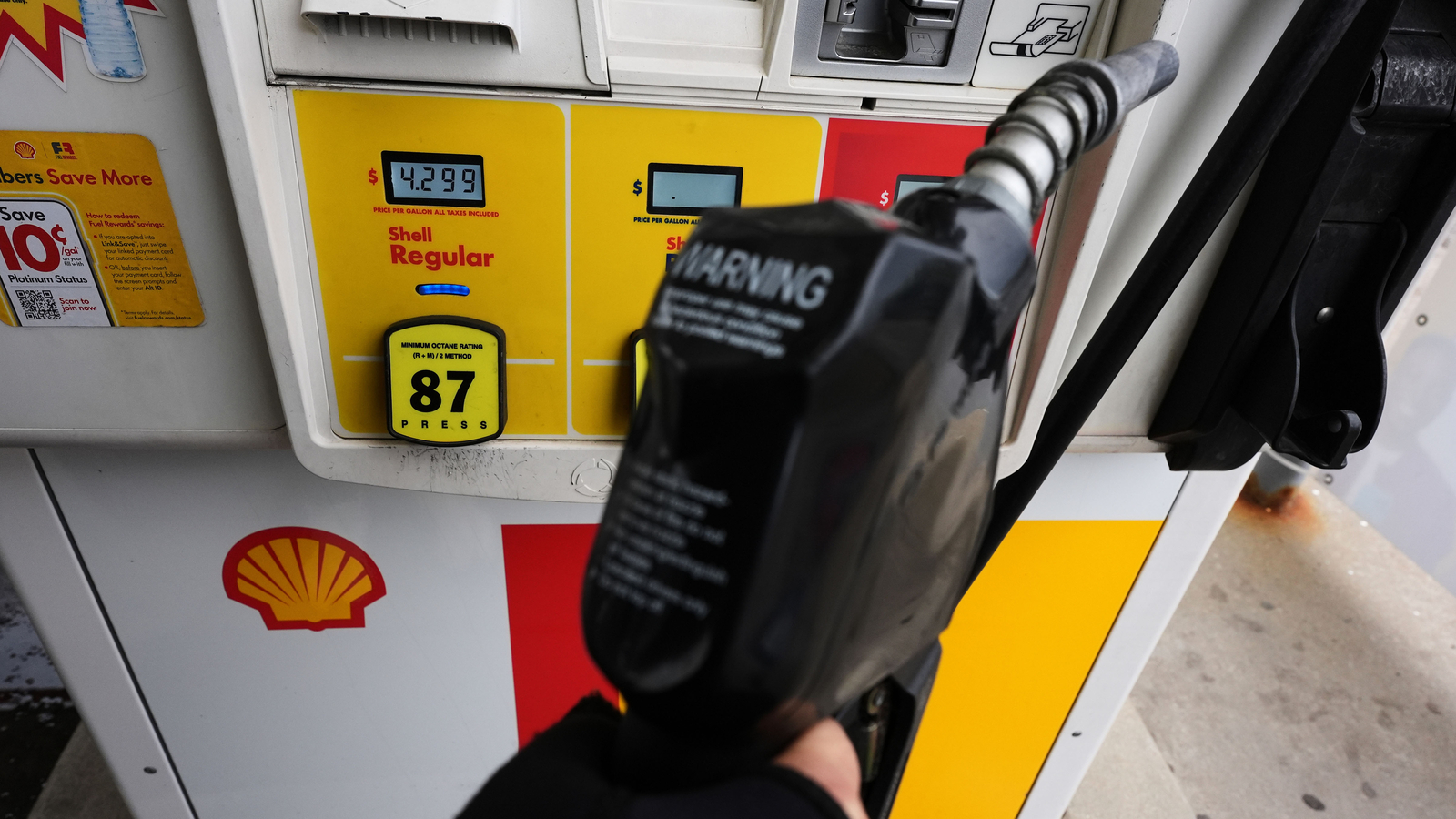
Brent crude briefly surged to $126.41 a barrel, its highest level in four years, before easing to $116.3 as traders priced in escalation risk from the US-Iran conflict and a prolonged Strait of Hormuz disruption. WTI was broadly flat at $106.7, while US gasoline prices hit a four-year high of $4.30 a gallon. The article highlights eight straight days of gains in crude and warns that further attacks on energy infrastructure could drive benchmarks sharply higher and worsen inflation and supply shortages.
The immediate market winner is not just upstream energy; it is volatility. When headline risk is dominated by a narrow geopolitical corridor, the best risk-adjusted expression is often long convexity in crude rather than chasing spot-beta equities, because the next leg is likely to come from a discrete interruption or policy misstep, not gradual fundamentals. That setup also favors refiners and commodity-linked transport hedges only after a delay, since their input-cost pass-through lags the front-end spike. The bigger second-order effect is margin compression across energy-intensive sectors with low pricing power. Chemical, packaging, industrials, airlines, and consumer staples with oil-linked inputs are the most vulnerable over the next 1-3 quarters, especially if the shock persists into summer driving season and inventory restocking amplifies demand destruction. In parallel, higher pump prices are a tax on discretionary consumption, so the real economy impact can surface before headline CPI fully reflects the move. The contrarian point is that the market may be underestimating the speed of policy reversal if prices remain disorderly. A sustained move above psychologically important levels tends to force diplomatic backchannels, SPR discussion, and demand rationing; that means the trade can reverse sharply once physical disruptions appear fully priced. In other words, the asymmetry is not in spot oil grinding endlessly higher, but in a burst higher followed by a violent mean reversion if shipping lanes partially reopen or military posture softens. For credit and equities, this is a classic cross-asset risk-off trigger: higher funding pressure, wider spreads in transport/consumer cyclicals, and relative resilience in cash-rich energy producers. The key is to separate beneficiaries of persistent scarcity from beneficiaries of volatility itself, because if the market transitions from fear to partial normalization, the latter can outperform even if crude stays elevated.
AI-powered research, real-time alerts, and portfolio analytics for institutional investors.
Overall Sentiment
strongly negative
Sentiment Score
-0.65
Ticker Sentiment
