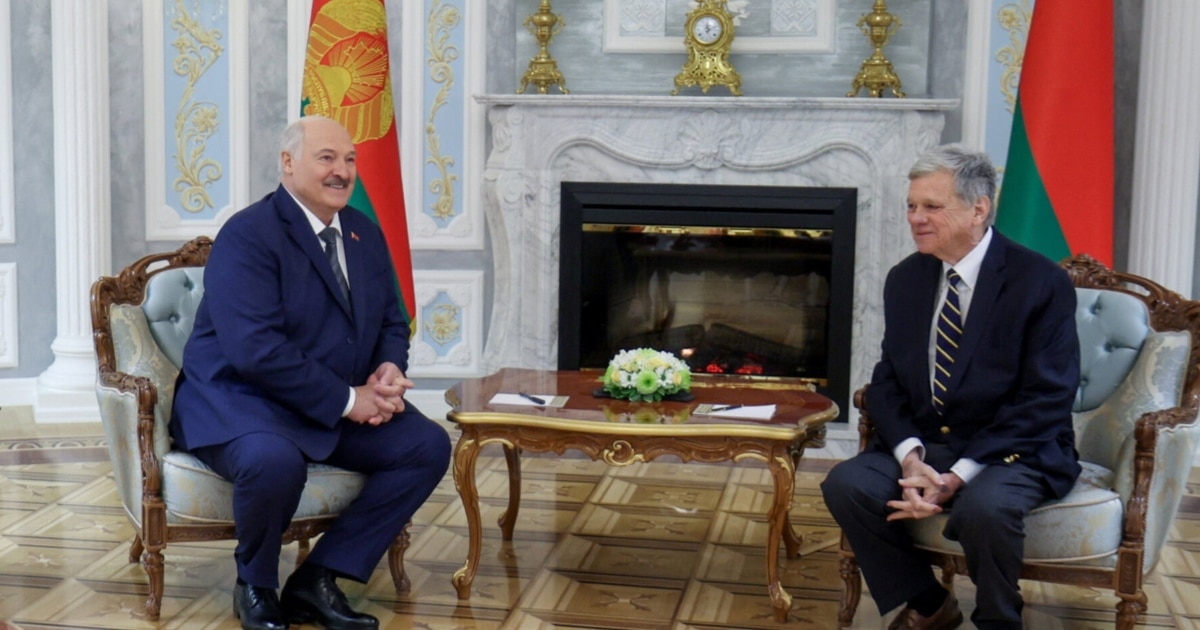
The US has moved to ease sanctions on Belarus—lifting restrictions on national carrier Belavia and on fertilizer exports including major producer Belaruskali—and secured the release of prisoners (including 123 released recently) as part of engagement aimed at using Minsk as a diplomatic conduit to Moscow. By contrast the EU is tightening measures, adding three new sanctionable criteria (information manipulation, attacks on EU public services/economic activities, and unauthorized entry) in response to incidents such as ~315 balloons from Belarus that disrupted Lithuanian airspace and forced airport shutdowns. The transatlantic policy divergence raises geopolitical and security risk for the region while creating potential market implications for fertilizer supply chains and related commodity prices; investors should monitor further sanctions decisions (including the EU’s anticipated renewal and inclusion in its 20th Russia package) and any shifts in Belarusian exports or transport disruptions.
Market structure: US easing of Belarus sanctions primarily shifts marginal global potash/fertilizer supply and insurance routing rather than immediately reopening EU trade lanes (EU borders remain closed). Incremental Belarusian supply could exert ~2–6% downward pressure on global potash benchmark prices over 1–3 months, compressing margins for highly exposed names and tightening pricing power of remaining non-Russian producers.
Risk assessment: Key tail risks include an EU counterreaction (late-February sanctions package) that re-seals markets or a broader Russia–EU escalation that disrupts transit — both could snap supply back tighter and spike prices >15% in weeks. Immediate volatility window: days–weeks around EU votes and prisoner/negotiation headlines; medium-term (3–6 months) depends on durable routing solutions and insurance availability; hidden dependency is third-country intermediaries (Turkey/China) and insurers that determine effective export capacity.
Trade implications: Prefer relative-value and convex positions: short concentration-exposed fertilizer equities and hedge with diversified producers; buy time-limited downside optionality rather than outright large shorts. Cross-asset: modest positive for Russian credit/RUB on normalization signals (1–3% move) and a defensive overweight to aerospace/defense equities if Europe doubles down on border/security spending.
Contrarian view: Markets may both over- and under-react — easing rhetoric alone is unlikely to deliver full export volumes quickly (supply ramp lag like past Iran oil reopenings). That argues for small, tactical positions sized for event risk, using options or pair trades to monetize a 5–15% repricing scenario rather than directional, concentrated bets.
AI-powered research, real-time alerts, and portfolio analytics for institutional investors.
Request DemoOverall Sentiment
mixed
Sentiment Score
0.00
