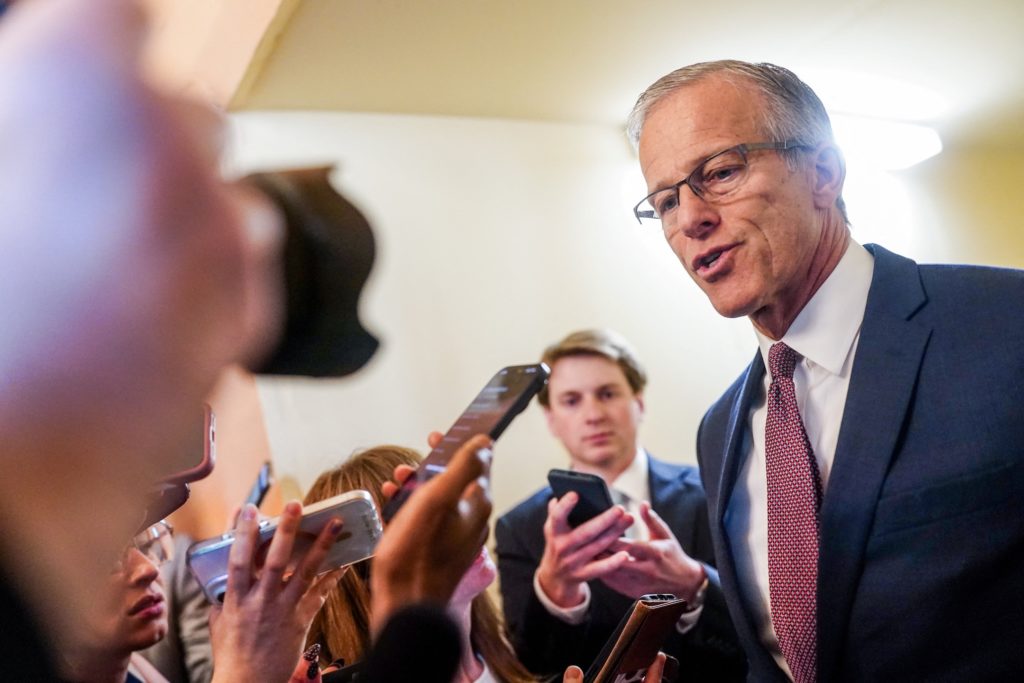
Senate GOP leader John Thune presented a 'last and final' DHS funding offer as a procedural vote to advance funding was halted, prolonging a budget standoff that risks Department operations and payroll disruptions; nearly 500 TSA officers have quit and lines at Houston's IAH reached up to four hours. Markets sold off sharply: the Dow fell more than 450 points (~1%), the Nasdaq dropped over 2%, and the S&P 500 recorded its worst day since January. Separately, Rep. Sheila Cherfilus‑McCormick faced a rare public House Ethics Committee hearing after an indictment, and a federal judge refused to dismiss the case against ousted Venezuelan president Nicolás Maduro; LaGuardia reopened a runway after this week's deadly Air Canada–fire truck collision, with most of roughly 40 injured released from hospitals.
Operational shocks at major airports are now a tangible supply constraint for North American carriers and will show up first as unit-cost inflation, not immediate revenue loss. A single aircraft write-off or multi-day runway outage typically converts into mid‑to‑high single‑digit percentage capacity reductions for the affected carrier over weeks, forcing re-accommodation costs, higher interchange rents for leased aircraft and accelerated spare‑parts consumption — all of which compress margins before any incremental fare re-pricing can occur.
Regulatory and staffing risk (DHS/TSA) has a convex profile into the summer travel season: a short funding impasse or payroll delay can push an already tight labor market into mass attrition, creating persistent schedule unreliability that depresses forward bookings and raises cancellation exposure for 2–3 quarters. That pattern benefits assets whose revenue is fee/transaction based (market infrastructure, derivatives venues) while penalizing asset-heavy network operators and insurable loss carriers through higher premiums and litigation accruals.
Market-structure players (exchanges, options venues) are the cleanest way to harvest episodic risk‑off flows because higher realized volatility and order flow typically lift take‑rate economics for a sustained window (weeks–months) even if headline risk fades. The main reversal risk is rapid political/administrative resolution (DHS funding, regulatory clarifications, insurer quick settlements) which would mechanically restore capacity, normalize volatility and re-rate impacted equities back toward fundamentals within a 1–3 month window.
AI-powered research, real-time alerts, and portfolio analytics for institutional investors.
Request DemoOverall Sentiment
mildly negative
Sentiment Score
-0.25
Ticker Sentiment
