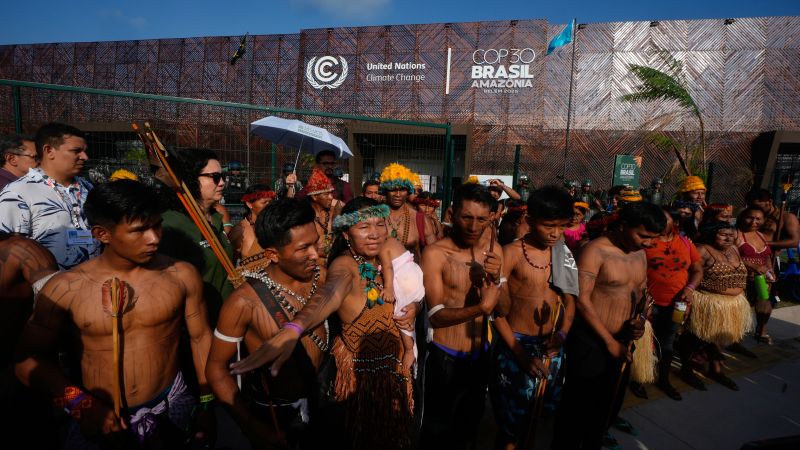
Indigenous protesters at the UN climate conference (COP30) in Brazil temporarily blocked the main entrance, demanding a meeting with President Lula and opposing agribusiness expansion, commercial river development, and a grain railway project due to deforestation concerns. They also called for clearer Indigenous territory demarcation and rejection of deforestation carbon credits. This action signals growing opposition to corporate-led development in the Amazon, posing potential regulatory and operational risks for investors in Brazilian agriculture, infrastructure, and environmental markets, particularly concerning land use and carbon credit integrity.
Indigenous protesters at COP30 in Belem, Brazil, executed a 90-minute blockade, demanding a meeting with President Lula and articulating strong opposition to agribusiness expansion and commercial river development. Key demands included halting a grain railway project due to deforestation fears, clearer Indigenous territory demarcation, and rejecting deforestation carbon credits. This represents the second such disruption in four days, indicating escalating social and political pressure.
The protests highlight significant dissatisfaction among Indigenous communities regarding the perceived inaction on climate change and corporate encroachment on their lands. Activists view these demonstrations as a critical "message and signal" that current environmental policies and development models are failing to address their concerns, particularly regarding Amazon preservation. This underscores a growing societal pushback against traditional resource extraction.
This escalating activism introduces tangible regulatory and operational risks for investors in Brazilian agriculture, infrastructure, and environmental markets. Explicit opposition to specific projects and carbon credit mechanisms suggests potential challenges to project approvals, land use policies, and the credibility of offset programs. The "moderately negative" sentiment and "uncertain" tone from signals reflect this heightened risk environment.
AI-powered research, real-time alerts, and portfolio analytics for institutional investors.
Request DemoOverall Sentiment
moderately negative
Sentiment Score
-0.50
