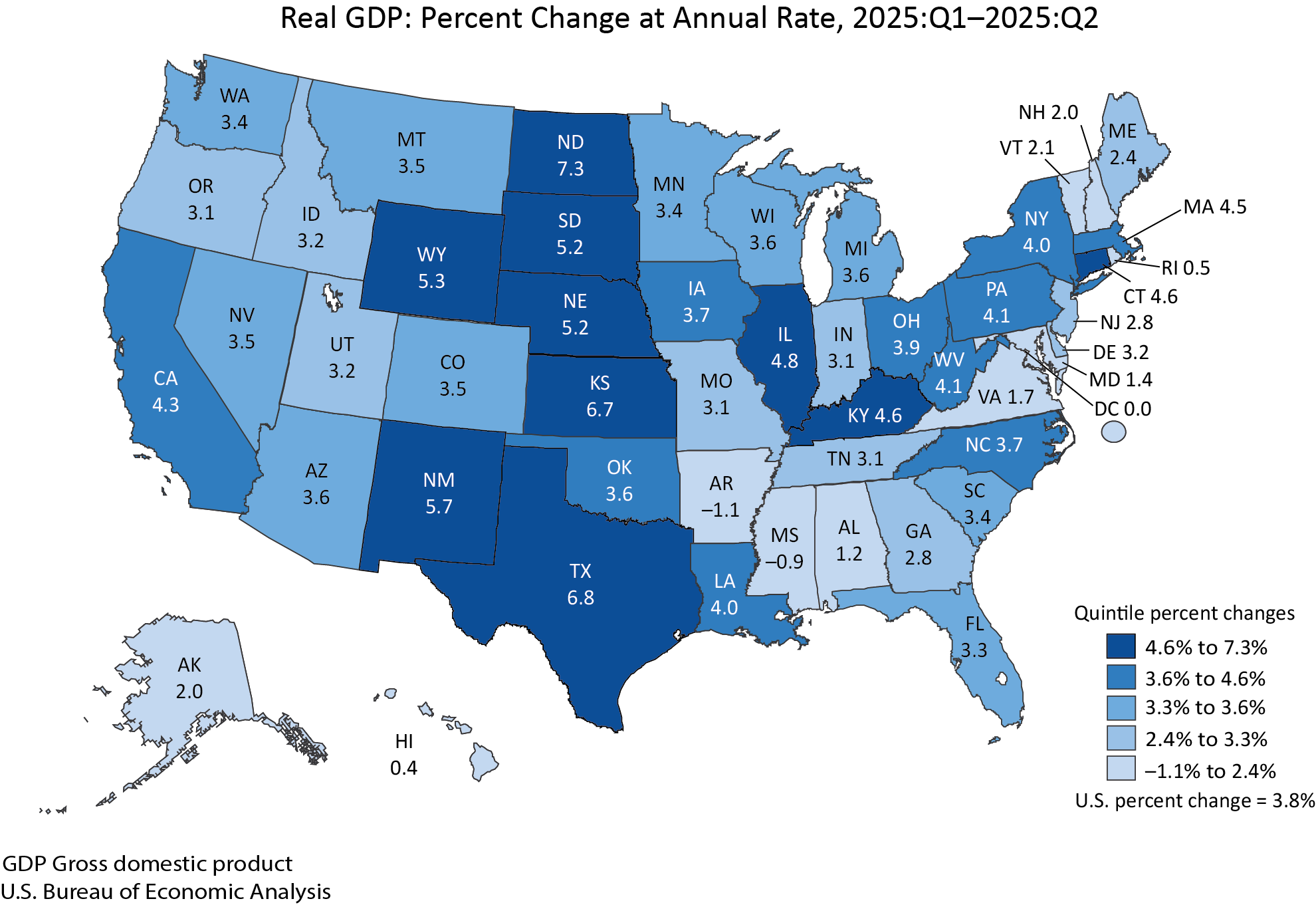
U.S. states demonstrated broad economic expansion in Q2 2025, with real GDP growing 3.8% nationally across 48 states and personal income rising 5.5% in all states, though significant variations existed, exemplified by North Dakota's 7.3% GDP surge and Kansas's 10.4% personal income jump. Growth was primarily driven by finance, information, and energy sectors, while personal income was notably boosted by transfer receipts, including retroactive Social Security payments. Concurrently, 2024 personal consumption expenditures increased 5.6% nationally, led by health care and housing, despite declines in energy goods and motor vehicles.
The U.S. economy demonstrated broad but uneven expansion in the second quarter of 2025, with national real GDP increasing at a 3.8% annual rate and personal income growing 5.5%. State-level performance varied significantly, highlighted by North Dakota's 7.3% GDP surge versus Arkansas's 1.1% decline, indicating regional economic divergence. Growth was led nationally by finance, insurance, and information, but the primary driver in top-performing states was the mining, quarrying, and oil and gas extraction industry, underscoring the strong performance of the energy sector. Personal income growth was universal but heavily supported by a 14.4% national increase in transfer receipts, partly due to the Social Security Fairness Act of 2024, which may represent a temporary, policy-driven stimulus rather than purely organic economic strength. The 2024 Personal Consumption Expenditures (PCE) data, showing a 5.6% national increase, reveals a cautious consumer, as spending growth was concentrated in non-discretionary categories like health care (+8.3%) and housing (+6.8%), while declining for gasoline and other energy goods (-5.2%) and motor vehicles, suggesting consumer sensitivity to prices and a potential cooling in demand for large durable goods.
AI-powered research, real-time alerts, and portfolio analytics for institutional investors.
Overall Sentiment
strongly positive
Sentiment Score
0.60
