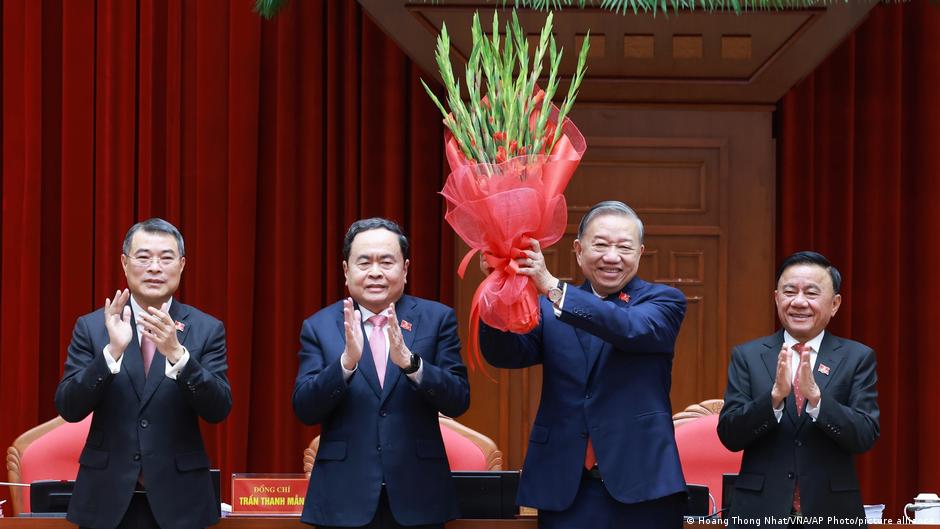
To Lam was unanimously elected president by parliament for a five-year term (495 deputies present endorsed, five absent), consolidating the party secretary and state president roles. He pledges stability, a "new growth model" targeting double-digit annual growth over the next five years, major administrative reforms (scrapping eight ministries, combining provinces) and greater defense self-reliance. The power consolidation mirrors China's governance model and raises political-risk concerns (greater authoritarianism) while potentially enabling faster decision-making for infrastructure and private-sector acceleration.
When political authority centralizes, expect a measurable shortening of decision cycles for large-scale public investment: permitting and interagency approvals historically compress by roughly 6–18 months, which pushes order-books for heavy civil contractors and input suppliers into the near term (3–9 months). That front-loaded capex tends to lift domestic demand for steel, cement and construction equipment, implying a potential 10–30% bump vs baseline demand over the next 12–36 months for firms with local production or concession portfolios.
Centralization also increases policy tail risk: localization requirements, tighter vetting of foreign partners, and episodic regulatory interventions become more likely, which can widen sovereign and corporate credit spreads by 150–300bps on stress. Banks and onshore lenders will see faster loan growth but face higher concentration and developer-credit risk; expect a divergence between high-quality state-backed borrowers (windfall) and private developers with thin balance sheets (vulnerable).
Geopolitically-driven defense self-reliance programs will reallocate procurement flows toward local assemblers and regional partners with production footprints inside the country, creating multi-year demand curves for certain OEM JV partners and component suppliers. Market moves will be front-loaded (days–weeks) on sentiment but the real structural winners and losers crystallize over 6–24 months as contracts are awarded and supply chains reconfigured; the principal reversal catalyst is either a renewed opening to large-scale foreign capital or a macro shock that forces policy retrenchment.
AI-powered research, real-time alerts, and portfolio analytics for institutional investors.
Overall Sentiment
neutral
Sentiment Score
0.00
