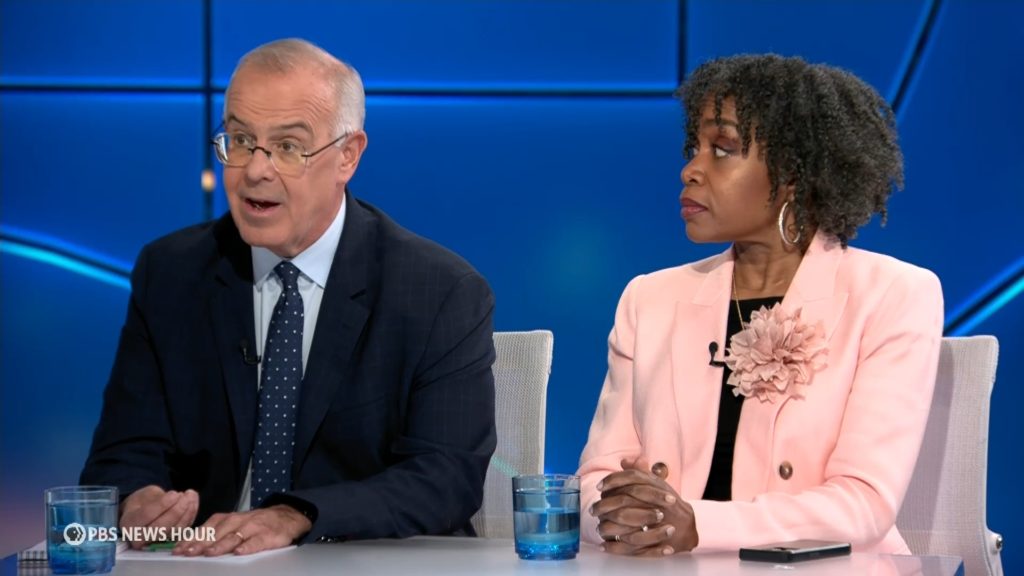
The piece assesses one year of President Trump's return to the White House as marked by aggressive executive action, politicization of the Department of Justice, and Supreme Court emergency rulings that have accelerated policy changes before their legality is resolved. Analysts warn these developments have eroded institutional capacity and rule-of-law norms, increased regulatory and political uncertainty ahead of upcoming elections, and together with broader geopolitical competition (notably China’s technological investments) create governance and policy risks that could complicate strategic planning and risk assessments for investors.
Market structure: Political risk from executive-aggressive governance shifts demand toward defense contractors (LMT, RTX, GD), energy producers (XOM, CVX) and security/outsourcing suppliers while pressuring small-cap consumer, travel and ad-driven media. Expect a rotation: 3–6% relative reweight from growth into value/defense in risk-off episodes; oil could spike 5–12% on geopolitical hawkishness, boosting energy cashflows and capex visibility.
Risk assessment: Tail risks include DOJ-directed litigation or asset seizures (idiosyncratic shocks to firms with government entanglement), abrupt tariff escalations with China, and election-driven market dislocations. Immediate (days–weeks) risk = volatility spikes around court rulings or indictments; short-term (1–6 months) = midterm election uncertainty and potential policy reversals; long-term (12–36 months) = structural decoupling and sustained higher defense/focus on reshoring.
Trade implications: The clearest plays are long defense/energy and short small-cap cyclical exposure, with options hedges around midterms and key Supreme Court/DOJ dates. Expect defense to outperform by +10–25% over 6–18 months if budgets rise; safe-haven TLT/GLD should appreciate ~3–8% in volatility rallies. Use calibrated option structures to cap hedge costs.
Contrarian angles: Consensus focuses on systemic breakdown; history (late-1890s/1930s) shows rupture often precedes concentrated consolidation and regulatory-driven winners. The market may overprice short-term political risk in large caps while underpricing eventual fiscal/defense stimulus — creating 6–24 month alpha opportunities in select cyclicals and government-contract suppliers.
AI-powered research, real-time alerts, and portfolio analytics for institutional investors.
Request DemoOverall Sentiment
moderately negative
Sentiment Score
-0.45
Ticker Sentiment
