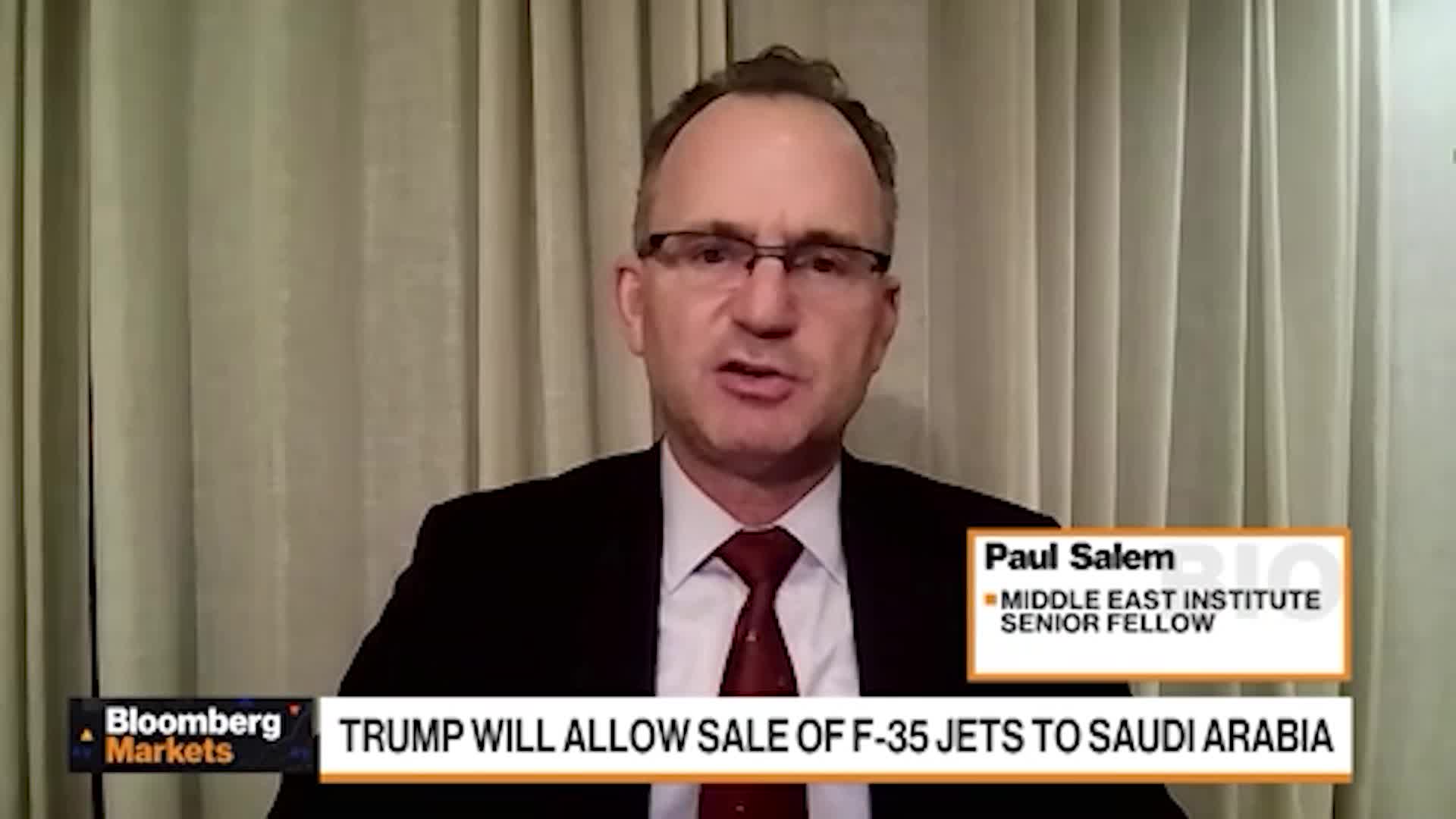
President Trump hosted Saudi Crown Prince Mohammed bin Salman amid ceremonial fanfare and discussions highlighting Saudi’s strategic economic and geopolitical importance, including an oft-cited cumulative investment figure the crown prince pegged at roughly $600 billion with aspirational talk of up to $1 trillion. Key takeaways for investors: a presidential announcement signaling a potential long-term sale of F-35 aircraft to Saudi Arabia — a process that would take years and raises U.S. national-security and Israeli concerns about sensitive technology — plus Washington push for Saudi normalization with Israel (contingent on Palestinian progress) and talks on Iran; Saudi demand for a U.S. defense treaty would require a two‑thirds Senate vote. The developments increase political and energy-sector risk premia but are incremental rather than immediately market-moving.
Market structure: Saudi signalling of up to $600bn–$1trn of mobilizable capital (via PIF and sovereign channels) disproportionately benefits US defense primes (LMT, NOC, RTX), US energy majors (XOM, CVX) and chip-capex suppliers (AMAT, LRCX, KLAC) through potential direct investment, order flow and higher region-risk premia. Losers: commodity-sensitive travel/airline stocks (UAL, AAL) and regional banks exposed to trade disruptions. Cross-asset: incremental Saudi dollar buying supports USD and US Treasuries (downward pressure on yields if allocations to bonds >$50bn), while oil risk-premia can lift breakevens and 2–10y yields if tensions rise >10% in crude.
Risk assessment: Tail risks include political pushback in US Congress blocking defense treaties or F-35 transfer (probability ~20% over 12 months) and a military escalation with Iran (low-probability >10% but high-impact: oil +20–30%). Time horizons: headlines move markets immediately (days), deal approvals/exports take 6–24 months, sovereign capital allocation affects markets over 12–36 months. Hidden dependency: most PIF capital to date has gone to private or domestic projects (Neom); public-equity inflows may be slower than rhetoric implies. Key catalysts: formal F-35 export license, PIF US investment memorandum (> $50bn), Senate votes within 120 days.
Trade implications: Prefer defensive/structured exposure: small, staged longs in LMT/NOC and semiconductor-equipment names funded by trimming cyclicals and short airline exposure; use options to buy asymmetric upside around approval decisions. Pair trades: long XOM vs short UAL on crude >$85/bbl trigger; use 3–9 month call spreads on XLE or Brent futures to express oil-risk. Entry: scale into positions over 4–12 weeks and re-rate on concrete PIF announcements or Senate votes.
Contrarian angles: Consensus assumes rapid public-equity inflows; historically (2016–2021) Gulf capital pledges convert slowly — risk that market has front-run allocation. If F-35 sale is delayed or conditioned heavily, defense names may be overbought; conversely, Saudi domestic spending could favor construction/materials versus US equities. Watch for Israel reaction and tech-security guardrails that could restrict dual-use transfers and slow transactions.
AI-powered research, real-time alerts, and portfolio analytics for institutional investors.
Request DemoOverall Sentiment
mixed
Sentiment Score
0.05
