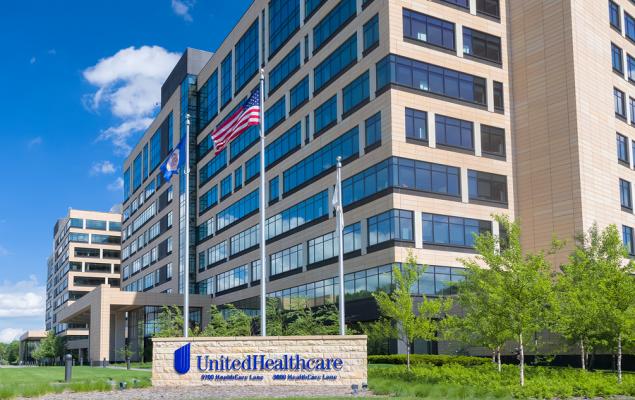
UnitedHealth is expanding a hybrid care model that blends in-person services with digital consults, remote monitoring and AI-driven analytics through UnitedHealthcare and Optum, and is extending parts of this approach into select international markets. The stock has declined 36.9% year-to-date versus the industry's 31.3% fall; UNH trades at a forward P/E of 18.27 (industry 15), carries a Zacks Value Score of A and a Zacks Rank #3, and the Zacks 2025 EPS consensus is $16.29—implying a 41.1% year-over-year drop. Competitors Elevance (Carelon) and Humana are advancing similar hybrid strategies, highlighting competitive pressures and execution risk despite potential improvements in convenience, cost and care continuity.
Market structure: Winners are integrated payor-platforms — UnitedHealth/Optum, healthcare IT vendors, and remote-monitoring device makers — because hybrid care shifts spend from episodic hospital revenue into recurring platform and device revenue; losers are stand‑alone fee‑for‑service hospitals and small physician groups that lack scale. Competitive dynamics favor firms that can marry claims data with care delivery (UNH, ELV, HUM), increasing negotiating leverage with providers and payers and compressing unit price inflation; expect top‑line reallocation rather than immediate industry growth. Cross‑asset: stronger cashflows at integrated players should modestly tighten their credit spreads (bps reduction), raise implied volatility around earnings for UNH/ELV/HUM, and be neutral for FX/commodities aside from durable medical goods demand upticks.
Risk assessment: Tail risks include antitrust enforcement against Optum’s vertical expansion, major data/privacy fines, and clinical liabilities from AI-driven care — each could swing equity value 15–35% and surface within 6–18 months if regulators act. Immediate risk window (days–weeks) centers on earnings and CMS telehealth guidance; medium term (3–12 months) on provider contract renewals and international rollouts; long term (2–5 years) on realized margin capture and reimbursement policy. Hidden dependencies: Medicare/Medicaid telehealth reimbursement, provider consent to data sharing, and successful international partnerships; catalysts are CMS rule decisions, big provider deals, and Optum EPS cadence.
Trade implications: Tactical: establish a limited long in UNH via Jan 2027 LEAP calls sized 1–2% NAV to capture structural upside while limiting capital at risk; add if forward EPS stabilizes within 3 quarters. Relative: pair trade long ELV (2–3% NAV) / short UNH (2–3% NAV) over 6–12 months to play execution variance — ELV favored for near‑term margin resilience. Options: buy a 3–6 month protective put on UNH ~10% OTM sized 0.5% NAV ahead of CMS/earnings; rotate proceeds into healthcare IT names and Humana (HUM) for home‑based care exposure.
Contrarian angles: The sell‑off (UNH down ~37% YTD) may overprice short‑term earnings pressure; consensus understates optionality of Optum international scaling and recurring software revenue — if Optum grows international revenue +15–25% YoY, multiples should re‑rate. Conversely, regulatory risk is underpriced; a blocked acquisition or significant penalty could reset valuations lower. Historical parallel: vertical industry restructurings (post‑M&A in banking/insurance) show multi‑quarter volatility before durable margins emerge — be prepared to hold 12–36 months for full realization.
AI-powered research, real-time alerts, and portfolio analytics for institutional investors.
Request DemoOverall Sentiment
mixed
Sentiment Score
0.05
Ticker Sentiment
